Anúncios
Do you dream of being the player who decides the match, but feel your progress has stalled in team practices? The truth is that the moments that define a star often happen far from the eyes of the coach and the fans. The extra dedication, the solo work and the relentless pursuit of technical perfection are the real game changers. At-home soccer training is the secret tool for anyone who wants to break through barriers and reach a new level of performance.
Training at home offers an invaluable competitive advantage: the freedom to focus intensely on your own weaknesses. Without time pressure or the judgment of teammates, you can repeat a dribble until it becomes instinctive, refine the accuracy of a pass against the wall until exhaustion or strengthen the specific muscles that will give you more explosiveness on the field. It is in this controlled environment that confidence is built, allowing you to take more risks and make faster decisions under pressure during games.
Anúncios
This complete guide was designed to be your definitive manual, turning any available space into a high-performance training center. We will cover everything from the non-negotiable fundamentals, like ball control and first touch, to advanced agility, coordination and bodyweight strength exercises. You will also find routines tailored to each position on the field — from goalkeepers to strikers — ensuring your effort is aimed at the skills that will really make a difference in your game. Get ready to unlock your true potential.
Why Training Soccer at Home Is Essential for Your Development
Think club practice is enough to stand out? The truth is that real progress happens when no one is watching. At-home soccer training offers a freedom the field does not: the freedom to make mistakes without judgment and to repeat tirelessly until you get it right, building a solid foundation for success.
Anúncios
The big advantage is total flexibility and personal focus. You can train at any time, adjusting the exercises to your specific needs, without pressure from the coach or teammates. This autonomy lets you concentrate exclusively on your weaknesses, turning weak points into strengths.
The benefits of home training add up and quickly become visible on the field. Every extra minute of dedication translates into more confidence to try bold plays and make quick decisions under pressure. That is the mindset that separates ordinary players from those who truly make a difference for the team.
Think of it as a personal lab for sharpening your skills. If the goal is to refine your passing accuracy, for example, the controlled environment at home is ideal. In fact, there is a lot to explore about how to improve your passing in soccer, and constant practice is the first step to mastering that art.
The Non-Negotiable Fundamentals: Essential Skills to Sharpen
Your game only improves if the foundation is solid. Before thinking about screamers or flashy dribbles, mastering the fundamentals of soccer is what separates good players from stars. Fortunately, you do not need a regulation field to build that foundation; your backyard, garage or even your living room can become your personal training center for essential skills.
The focus here is on repetition and quality of movement, not intensity. Every touch of the ball, every pass against the wall, is another brick in building your game. Skipping this stage is the fastest route to stagnation, no matter how naturally talented you are.
First Touch and Ball Control: The Foundation of Everything
Ball control is your first language on the field. It is the ability to make the ball obey you, to keep it close to your body under pressure and to set it up for your next action, whether a pass, a dribble or a shot. Without it, every other play becomes a coin toss, and you become a predictable player who is easy to mark.
To train at home, start with the basics: juggling to improve your touch and feel for the ball. Use makeshift cones, such as bottles or shoes, to create small circuits and practice dribbling in tight spaces, alternating between the inside and outside of your foot. These simple exercises, repeated consistently, are the hidden detail in soccer training that improves your technique exponentially.
Passing Accuracy and Shooting Power
A misplaced pass breaks the team’s rhythm, while a weak shot wastes a golden chance. Improving your passing and shooting at home is entirely possible and requires a focus on correct technique. The wall is your best friend here; it never returns a bad pass and is always ready for one more rep.
Use a wall to practice short, quick passes, focusing on always hitting the same spot and using both feet. Accuracy matters more than power at first. For shooting, if you have a safe space, concentrate on your body posture and the motion of your foot as you strike the ball, prioritizing technique over raw power. There are plenty of tricks to refine this skill, and understanding how to improve your passing in soccer can transform your team play.
| Skill / Position | Key At-Home Exercise | Main Focus |
|---|---|---|
| Fundamentals (All) | Dribbling between makeshift cones | Ball control, agility and coordination |
| Goalkeepers | Reacting to balls kicked against the wall | Quick reflexes and reaction time |
| Defenders | Lateral movement in a “corridor” | Defensive stance, agility and anticipation |
| Midfielders | Short, quick passes against the wall (both feet) | Directional first touch, rhythm and distribution accuracy |
| Strikers | Quick finishing at a specific target | Technique, accuracy and speed of execution |
Agility and Coordination Exercises: Transform Your Performance
Is your opponent fast? You need to be faster. Pure speed is useless without the ability to change direction, react and stay in control. Agility exercises and coordination work are what separate good players from decisive stars, and the best part is that you can sharpen these skills in your bedroom or garage.
An Agility Ladder Adapted for Home
Forget the professional ladder. Use tape, string or even the lines on your floor to create the “rungs” on the ground. The goal here is foot speed and light movement, not distance covered. Keep your body low and your knees bent to maintain a stable center of gravity, ready to explode.
Start with the basics: one foot in each square, then two feet. Progress to lateral movements, hops and the classic “in-in-out-out”. The key is to perform the movements explosively and precisely, minimizing the time your feet spend on the ground and improving your soccer motor coordination.
Circuits with Cones or Makeshift Markers
Water bottles, shoes, flip-flops, anything can become a cone. Set up a small circuit in the space you have available to simulate game situations. The idea is to force quick, explosive changes of direction, a pillar of soccer-specific functional training that makes you as slippery as an eel.
Variations for Beginners and Advanced Players
If you are just starting out, focus on performing the movement correctly without the ball, maintaining body control in zigzags and runs with changes of direction. Speed will come with practice and confidence. Do not rush; quality of movement matters more than initial speed to avoid bad postural habits.
For advanced players, the challenge increases dramatically: add the ball. Dribble at high speed through the markers, using the inside and outside of your foot. Try to keep the ball close and your head up, reading the “field” in front of you, even if it is just your living room.
Improving Hand-Eye and Foot-Eye Coordination
The connection between your eyes and your feet (foot-eye coordination) is what defines a quality first touch. Take a tennis ball and kick it against a wall, focusing on controlling the rebound with a single touch while alternating feet. This refines your reception of the ball and prepares you to control quick passes on the field.
This practice is exactly The Hidden Detail in Soccer Training That Improves Your Technique, because it works on reaction time in isolation. In addition, good hand-eye coordination, like bouncing a tennis ball off the wall and catching it, is essential for goalkeepers but also helps outfield players develop better spatial awareness. Sharpening this connection is one of the hacks for anyone looking to improve their passing in soccer, since perfect control is the first step toward accurate distribution.
Soccer-Specific Strength Training at Home
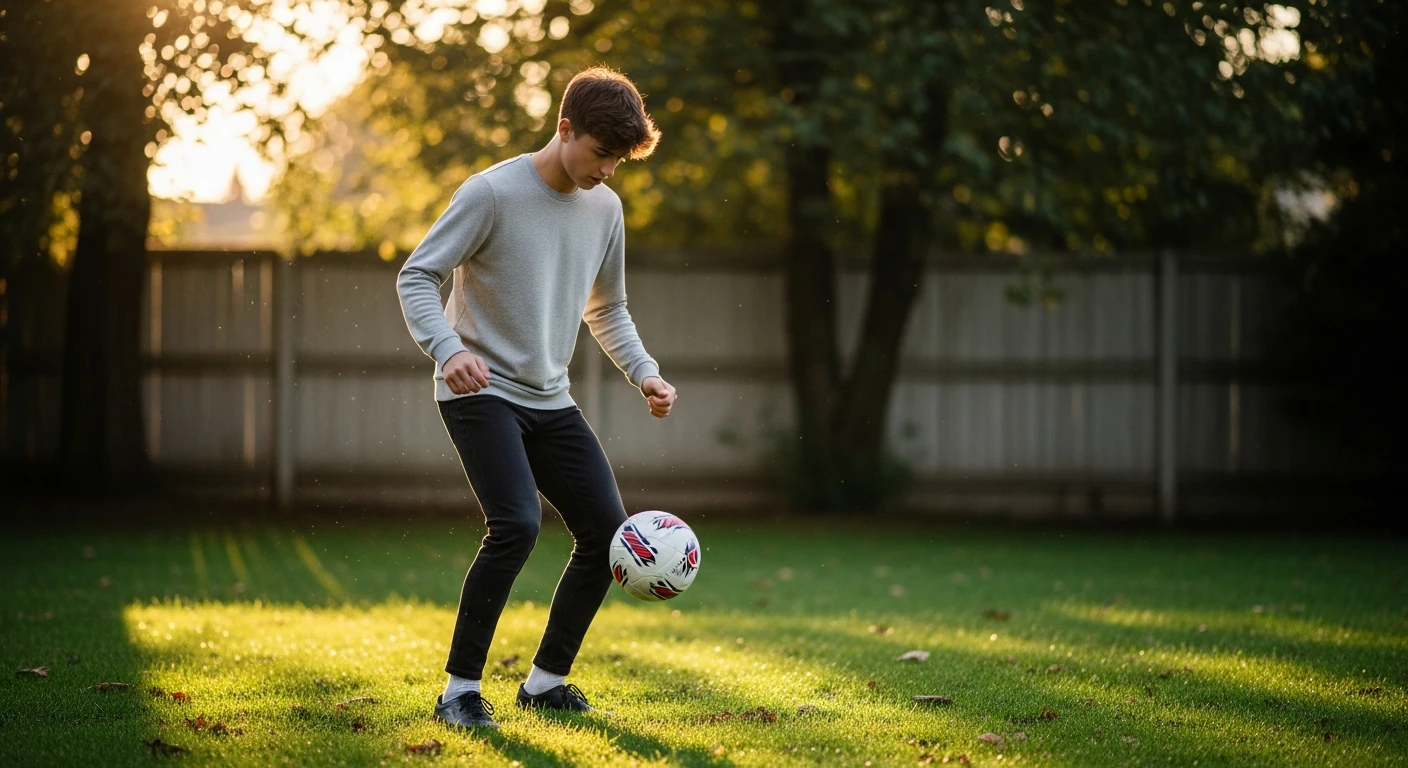
Forget the gym. The strength that decides games is built on your living room floor. Soccer strength training is the foundation for explosiveness, endurance and handling the physical grind of 90 minutes without asking to come off. With discipline and your own body weight, you build the frame of an elite athlete, preparing your body for the challenges of the field.
Legs of Steel: Squats and Lunges
Your legs are your engines, and they need high-octane fuel. The bodyweight squat is the king of leg exercises, working the quads, glutes and hamstrings together. To add an explosive component, include jump squats, which simulate the leap needed for headers and aerial duels. Do three sets of 12 to 15 reps, focusing on correct form to avoid injuries.
Next, the lunge tackles muscle imbalances and improves the stability of each leg individually. This movement is crucial for quick changes of direction and for power when striking the ball. Alternate legs and feel the focused work, which is essential for having a firm base when shielding the ball or finishing accurately.
The Importance of the Core for Stability and Power
Your torso is the bridge that connects the power of your legs to the movements of your whole body. A weak soccer core means poor balance, weak shots and a higher risk of lower back injuries. Strengthening this area is what lets you rotate your body for a powerful shot, stay on your feet in a shoulder-to-shoulder battle and have the agility to dribble.
Exercises like front and side planks are essential for building this stability isometrically. Hold the position for 30 to 60 seconds, keeping your abs tight and your body aligned. Many players focus only on the ball, but physical conditioning is the hidden detail in soccer training that improves your technique, making sure your body carries out what your mind commands.
Individual Tactical Training: Thinking the Game in Your Own Space
Thought tactics were only for when the whole team is together? Wrong. Your bedroom or backyard can become a mental battlefield. Use cones, bottles or even flip-flops to simulate opponents, and individual tactical training begins with you creating pressure situations, forcing yourself to think fast and shield the ball in tight spaces.
The key is reading the game before the ball even reaches your feet. When doing a first-touch exercise, visualize where the next pass would go and position your body to play it. This anticipation is what turns simple possession into a dangerous play, and it is one of the hacks for anyone looking to improve their passing in soccer.
Correct soccer positioning can be trained even with no one around. Practice receiving the ball while already turning your body to look at the imaginary field in front of you. Get used to taking quick touches to escape pressure, even if the marker is just a cone, because this mental agility separates good players from stars.
Tailored Routines: Adapt Your Training to Your Position
Generic training will not make you a star. Each position requires a specific set of skills, and your at-home soccer training needs to reflect that. Ignoring the particulars of your role on the field is the fastest route to stagnation, limiting your real impact on the game. Learn how to direct your effort to become dominant in your area of the field.
Goalkeepers: Reflexes and Agility in the Six-Yard Box
For those who live between the posts, explosive power and reaction time are everything. At-home goalkeeper training should focus on short, intense movements. Use a wall to train your reflexes, throwing the ball with different force and from different angles to simulate unexpected deflections and force your body to react quickly.
Jumping and Diving Exercises
On grass or a soft surface, start with lateral jumps over a cone or low obstacle, focusing on a balanced landing. For diving, practice the movement without the ball, starting from a kneeling position to learn how to cushion the impact with the side of your body. Correct technique here prevents injuries and increases your confidence to go for difficult balls.
Defenders: Marking and Anticipation
A center back who only chases the striker has already lost the play. The secret is anticipation, and that is trained through agility and body positioning. Use cones to create a “corridor” and practice lateral movement, always with your body side-on, ready to tackle or track a burst of speed. This defensive stance is essential for closing down space and intercepting passes.
Tackling and Cover Simulations
Place cones as if they were strikers. Step toward a cone and fake a tackle, then quickly drop back to your original position, simulating cover. Vary the speed and direction, training the change of pace that disrupts opponents’ movement and keeps you one step ahead in the battle for the ball.
Midfielders: Vision and Distribution
The team’s engine needs control and intelligence. For a midfielder, training at home means refining the directional first touch and passing quality. Every touch of the ball should have a purpose, setting up the next play. Practicing your first touch while already turning your body is essential to speed up the game.
Short and Long Passing Practice
A wall is your best ally here. Practice short, quick passes, alternating feet to develop two-footedness and rhythm. For long passes, increase your distance from the wall and work on your strike, aiming for accuracy rather than raw power. If you want to know how to improve in this area, there are quick hacks that transform your game and can be applied immediately.
Strikers: Finishing and Movement
At-home striker training is about creating chances and being lethal. Movement off the ball is crucial to shake off your marker. Practice short sprints with sharp changes of direction, simulating the hunt for space inside the box. Combine this with quick turns, controlling an imaginary ball and setting your body for the shot.
For finishing, use a target on the wall or a small goal. Practice quick shots after a short first touch, focusing on accuracy into the corner. You do not need power, but technique and speed of execution, catching the goalkeeper by surprise. This repetition turns finishing into a natural instinct.
Building Your Weekly At-Home Training Plan
Forget improvising. Your talent needs a plan to truly take off. Having a well-defined soccer training plan is what separates the player who improves from the one who stagnates, just kicking the ball around for the sake of it. The key is training consistency, mixing high-intensity days with smart recovery to avoid injuries and physical burnout.
Organization is the secret to turning your effort into real results on the field. Without structure, you risk overtraining one fundamental and neglecting others, creating an imbalance in your game. Think of your weekly plan as a map to success, guiding every step of your development.
Structuring Training Days and Active Rest
To create an effective exercise routine, aim for three to five training sessions a week, lasting 45 to 60 minutes each. The ideal frequency depends on your current level and how much your body can handle. Remember, quality beats quantity; a focused session is worth more than hours of sloppy practice. Organize the days to vary the stimulus, alternating technical sessions with physical ones.
For example, you could dedicate Monday to agility and ball control, Tuesday to strength and explosiveness, and Thursday to passing and finishing technique. Wednesday can be an active rest day, with a light walk or stretching to help muscle recovery. This variety ensures you work on all physical and technical qualities in a balanced way, building the profile of a complete athlete.
The Importance of Warming Up and Cooling Down
Skipping the warm-up is the biggest trap for any player. It is a basic mistake that costs dearly, often in the form of an injury. A good 10-minute warm-up prepares your body and mind for the effort, increasing blood flow, warming up your muscles and improving your neuromuscular response. Do dynamic movements like jumping jacks, light jogging and hops before touching the ball.
Likewise, the cool-down is non-negotiable. After intense training, your body needs a smooth transition back to a resting state. Spend 5 to 10 minutes on a very light jog and static stretches, holding each position for 20 to 30 seconds. This helps reduce delayed-onset muscle soreness and speeds up recovery for your next session.
Understanding the purpose of each stage of training is often the hidden detail in soccer training that improves your technique and prevents injuries. Treating your body professionally, even when training at home, is what will put you on a different level. This discipline separates those who dream from those who earn their place on the field.
Resources and Tools to Boost Your Home Training
Your home training goes to another level with the right tools. Forget expensive gyms; your greatest ally can be a wall for practicing passes and finishing. Use cones, bottles or even flip-flops to create agility and ball control circuits, turning any space into an arena for personal development.
Technology is also on your side. There are countless soccer training apps that offer exercises, track your progress and even analyze your movements. In addition, video platforms are full of high-quality tutorials, from basic fundamentals drills to complex fitness sessions, created by professionals and athletes.
The secret is not the amount of equipment, but consistency and intelligence in how you use it. These simple resources are the path to discovering The Hidden Detail in Soccer Training That Improves Your Technique and sets you apart from the rest. With creativity and discipline, you have everything you need to improve without leaving home.
Turn Your Dedication into Dominance on the Field
We have reached the end of this guide, but for you, it is just the beginning of a new journey. The main message is clear: talent may open doors, but it is discipline and consistency in training that will get you through them and help you stand out. At-home soccer training is not just a supplement, but a fundamental pillar for anyone pursuing excellence. Every agility drill, every pass against the wall and every strength rep builds the foundation for your body to execute on the field what your mind envisions. Do not wait for perfect conditions or your next club practice. Start today, with what you have, and turn your space into your personal lab for success. Real progress happens when no one is watching.
Frequently Asked Questions About At-Home Soccer Training
How long should I train soccer at home each day?
Consistency matters more than duration. Ideally, train 3 to 5 times a week in focused sessions of 45 to 60 minutes. This allows for continuous development without overloading your body, leaving time for muscle recovery.
What equipment is essential to start training soccer at home?
You can start with the basics and get creative. The essentials are a soccer ball, a space with a sturdy wall for practicing passes and shots, and markers such as cones, which can be improvised with bottles, shoes or other objects.
Is it possible to improve physical endurance by training soccer at home?
Yes, it is entirely possible. Agility circuits, jumping jacks, burpees and jump squats are excellent for raising your heart rate and improving your cardiorespiratory capacity. Combining these strength and explosiveness exercises builds the endurance you need for 90 minutes of play.
How can I avoid injuries when training soccer at home?
To train safely, always start with a complete warm-up to prepare your muscles and joints. Focus on performing the movements correctly, prioritizing quality over quantity or speed. Also, respect your rest days and listen to your body’s signals to avoid overtraining.
Can I train at home if I do not have much space?
Absolutely. Many fundamental exercises require little space. You can practice juggling to improve your touch, stationary ball control exercises, short passes against the wall and core strengthening, such as planks and crunches, which are crucial for stability on the field.