Anúncios
On a soccer pitch, the ball is the star, but the pass is the screenwriter who dictates the plot of every move. A precise touch can be the difference between sterile possession and a brilliant assist that puts the striker one-on-one with the goalkeeper. Many players focus on shooting power or running speed, but forget that true soccer intelligence shows in the ability to connect the team and make the ball flow with purpose. Mastering the art of passing isn’t just a technical skill; it’s the key to unlocking a new level of control and creativity on the pitch.
The quality of your passing directly reflects your understanding of the game. It’s the language you use to communicate with your teammates, the tool you use to take defenses apart and the foundation on which great plays are built. From the short pass that keeps the rhythm and tires the opponent to the long ball that sparks a counterattack, each type of pass has its moment and its strategic purpose. Ignoring the importance of improving this skill is like trying to write a book knowing only half the alphabet: your possibilities will always be limited.
Anúncios
This ultimate guide was created to be your complete manual on the journey to passing mastery. We’ll dive deep into the fundamentals, detailing perfect body mechanics, from the position of your standing foot to the ideal contact with the ball. You’ll discover the different types of passes and when to use them, and learn how to develop the vision and anticipation that separate good players from true playmakers. With practical individual and group drills, you’ll have a clear roadmap to fix common mistakes and turn your passing into one of your most powerful weapons on the pitch.
The Essence of Passing in Soccer: More Than a Simple Touch
Passing is the secret weapon that defines championship teams. Far from being just a touch of the ball, it’s the universal language of the pitch, what turns a group of individuals into a cohesive and dangerous unit. Without accurate passing, the most brilliant tactics collapse and individual talent gets lost in isolated, unproductive plays.
Anúncios
Mastering the pass means controlling the tempo of the game, breaking down the opposing defense intelligently. A single well-executed pass can dismantle an entire defensive line, creating a clear scoring chance where there was nothing before. It’s the perfect combination of technique, which is part of soccer training, and excellent vision in soccer to find the right space.
This is one of the main fundamentals of soccer, requiring not only skill with your feet but also strong communication on the pitch. Improving this skill is what separates good players from true stars. It’s the element that builds plays, dictates the flow of the match and, at the end of the day, puts the ball in the net.
Types of Passes: Explore the Complete Player’s Arsenal
Every pass is a play, a message to your team. Knowing the different types of passes and when to use each one turns an ordinary player into a midfield maestro. It’s not just about moving the ball, but about dictating the tempo, breaking down defenses and creating scoring chances out of nothing.
Short and Medium Passes: Accuracy and Tempo
The bread and butter that wins championships. The short pass is the foundation for keeping possession, drawing in the opponent and building the play with patience and intelligence. Executing it requires surgical precision, using the inside of the foot to make sure the ball arrives softly and in the right direction for your teammate. This type of pass is the essence of Soccer Fundamentals: The Complete Guide.
The medium-range pass, meanwhile, is the tool for speeding up the transition from defense to attack, connecting different areas of the pitch. It requires more power, but without sacrificing accuracy. Mastering these passes lets the team stay in control and find gaps in the opposing defense, shifting the defensive block from side to side until an opening appears.
Long Passes and Through Balls: Vision and Transition
This is where the magic happens. The long pass, or long ball, is the weapon for catching the defense by surprise, quickly switching play or releasing a striker at speed. This move doesn’t depend only on striking technique, but requires sharp tactical reading, something explored in depth in Vision in Soccer: How to Develop It.
Beyond the more traditional passes, a standout player’s arsenal includes creative touches, such as the famous backheel pass. Used at the right moment, it can embarrass a marker and put a teammate through on goal. It’s a resource for players with confidence, technique and the daring to break the pattern and decide a match with a single stroke of genius.
| Essential Technique | Description | Golden Tip |
|---|---|---|
| Body Positioning | The foundation of an accurate pass. It includes a firmly planted standing foot beside the ball, bent knees and a slightly forward-leaning torso. | Point your standing foot directly at your target. It works as the sight for your play. |
| Contact With the Ball | The way your foot strikes the ball. The inside of the foot (side-foot) for accuracy, the instep for power. | Lock your ankle at the moment of impact to ensure a firm, low pass that stays on the ground. |
| Vision | The ability to scan the pitch and know where your teammates and opponents are before receiving the ball. | Get into the habit of checking over your shoulder before your first touch. Know what you’ll do before the ball arrives. |
| Wall Training | A fundamental individual drill for repetition, controlling the weight of the pass and improving your first touch. | Vary the distance and power of your passes against the wall, practicing with both feet to become a complete player. |
Perfect Mechanics: The Technique and Execution of a Good Pass
Do your passes come out weak or off target? Does the ball not go where you aim? The truth is that a quality pass doesn’t happen by chance, but from refined passing technique repeated over and over. Neglecting the details of body mechanics is the fastest way to gift the ball to the opponent and kill a promising move. It’s time to understand that every part of your body plays a key role in the execution.
Mastering these movements is the difference between an ordinary player and one who dictates the tempo of the game. It’s not just about kicking the ball, but commanding it with surgical precision. Refining these movements is one of the pillars of Soccer Fundamentals: The Complete Guide, turning a simple touch into a brilliant assist.
Body Positioning: The Foundation of Everything
It all starts before you even touch the ball. Your body positioning is the foundation of a perfect pass. Your standing foot should be planted firmly beside the ball, at a comfortable distance, pointing directly at your target. A poorly placed standing foot throws the whole movement off balance and results in an inaccurate pass.
Keep your knees slightly bent for stability and agility, allowing a smoother transfer of energy. Your torso should lean slightly over the ball, with your arms out for balance. This compact, stable posture is the launch pad for any type of pass you want to play.
The Point of Contact With the Ball
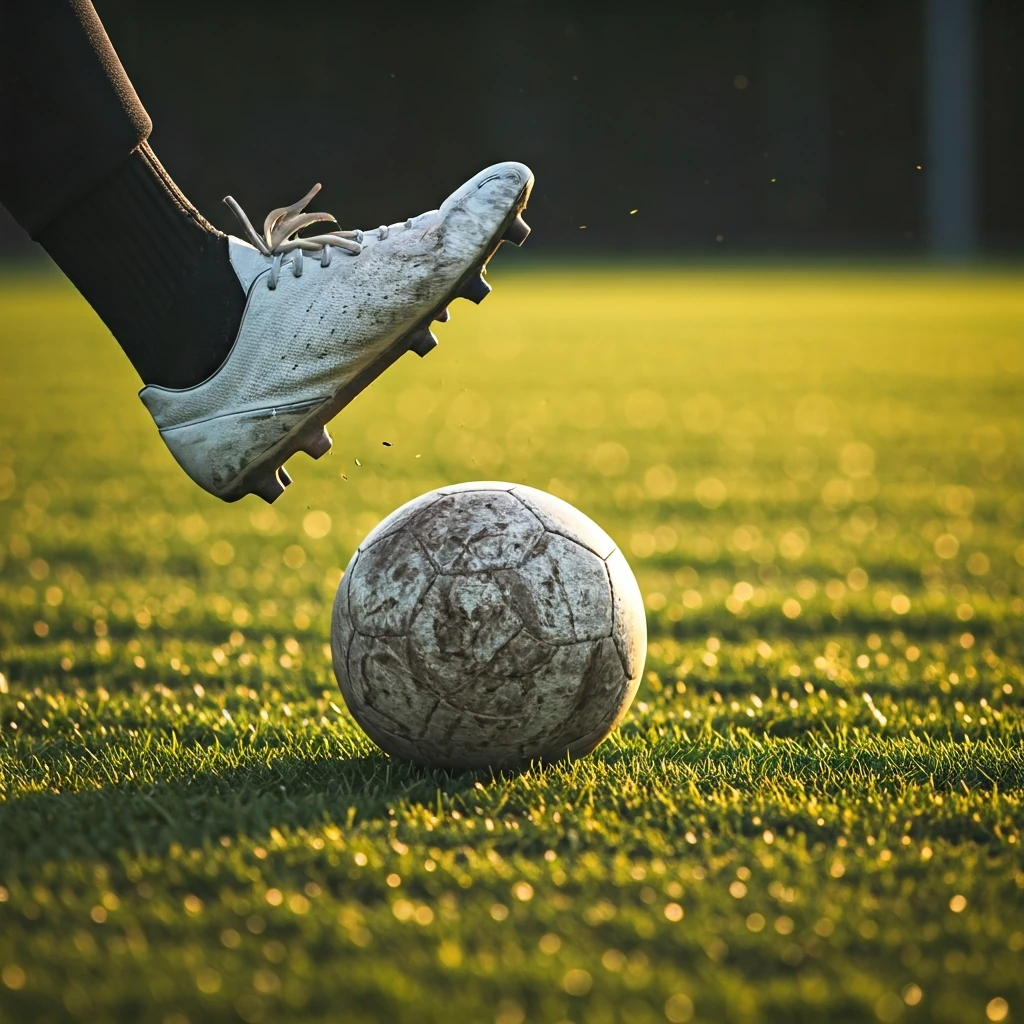
The secret to accuracy lies in where and how your foot meets the ball. For short, high-precision passes, the ideal is to use the inside of your foot, the classic side-foot pass. Contact with the ball should happen right in its center, making sure it rolls along the ground without bouncing out of control. Lock your ankle at the moment of impact to transfer power cleanly.
For longer or faster passes, the instep (top of the foot) is the best option, generating more power. The “trivela,” played with the outside of the foot, is an advanced resource for curling passes that fool the defense. Mastering these variations lets you adapt to any game situation, choosing the right tool for each moment.
Follow-Through and Directing the Pass
Many amateur players make the mistake of stopping the motion right after contact with the ball. The follow-through is just as crucial as the strike itself. After impact, your kicking leg should continue moving toward your teammate. This motion ensures that power and direction are maintained to the end.
Think of your foot and leg as a guide pointing the way the ball should travel. A short, stiff follow-through results in a weak pass with no direction. A smooth, complete motion that ends with your foot pointing at the target is the signature of a well-executed, intentional pass.
Power and Trajectory: Fine-Tuning Perfection
Adjusting the power and trajectory of the pass is where technique meets soccer intelligence. The power you apply depends on the distance and the situation; a short pass in the box requires a subtle touch, while a switch of play needs power. This constant calibration is what defines an elite passer and is directly linked to your Vision in Soccer: How to Develop It.
Trajectory is also fundamental. A ground pass is faster and easier to control, ideal for building play. A lofted pass can get over a compact defensive line, but it demands even greater precision in touch and power. Practicing all these variables is the only way, and a good Soccer Training: Sharpen Your Technique plan is essential to turn theory into real skill.
Vision and Anticipation: The Secret of Great Passers
The perfect pass isn’t born in the feet alone. It begins in your head, long before the ball arrives. True vision means constantly scanning the pitch, lifting your head and knowing where your teammates and opponents are positioned. Get into the habit of checking over your shoulder to map out the space even before you control the ball.
This spatial awareness is what enables anticipation in passing. Instead of reacting to what’s happening, you start predicting the next moves, playing the ball to where your teammate is going to be, not where he is. Good game reading turns a simple pass into a brilliant assist, breaking lines and creating clear chances. Developing this skill is an ongoing process, and learning more about Vision in Soccer: How to Develop It can speed up your progress.
So the secret is to think one or two steps ahead of everyone else. When you receive the ball, you should already have two or three passing options in mind, deciding which is best based on how the defense is moving. This speed of thought, combined with the right technique, is what separates average players from true midfield maestros.
Essential Drills to Improve Your Passing: From Basic to Advanced
Enough theory; it’s time to work up a sweat and really refine your passing. Progress in soccer doesn’t happen by magic, but through constant, smart training. We’ve put together some drills, from the most basic to advanced, for you to add to your routine and transform the way you distribute the ball on the pitch. These are the pillars of any results-driven soccer training.
The secret to a perfect pass lies in the combination of refined technique and relentless repetition. Before thinking about complex passes, you need to master the fundamentals of soccer. A well-executed touch with the inside of the foot, a firm medium-range pass and control of the weight of the pass are the foundation of everything. Without them, any attempt at a more elaborate play is doomed to fail.
Individual Drills: Fundamentals and Repetition
The journey to elite passing begins when you’re alone with the ball. Repetition is your greatest ally for building muscle memory and automating the correct movements. This is when you build familiarity with the ball, understanding how each touch affects its trajectory and speed, one of the key soccer drills for any position.
Wall and Cones: Accuracy and Control
The wall is the best friend of anyone who wants to improve passing accuracy. Stand a few yards from a wall and practice passes with both feet, varying the power and the part of the foot making contact. Focus on controlling the ball with your first touch as soon as it comes back. To add a challenge, place cones as targets against the wall or set up a small circuit to dribble the ball and pass on the move, improving your control and agility.
Partner and Group Drills: Communication and Dynamics
When you add a teammate, the dynamic changes completely. Passing is no longer just a mechanical act and starts to involve timing, space and mutual understanding. Communication on the pitch becomes vital; a simple gesture or look can be the difference between a pass that breaks the defensive line and a ball lost to the opponent.
Rondos and Possession Games: Pressure and Decision-Making
The famous rondo, known in Brazil as “bobinho,” is one of the most effective drills there is. In a small space, a group of players tries to keep possession while one or two defenders try to win the ball. This drill forces you to think fast, use your body to shield the ball and play accurate first-time passes under intense pressure. It’s a fundamental drill for developing vision in soccer and making decisions in fractions of a second.
Game Simulations: Putting It Into Practice
The final stage is applying everything you’ve trained in situations that mimic a real game. Small-sided scrimmages, with teams of 3, 4 or 5 players, are perfect for this. The intensity is high, the spaces are tight and every touch of the ball counts. In these scenarios, you’re forced to use your passing technique, your communication and your decision-making in an integrated way, preparing you for the challenges of an official match.
Communication and Chemistry: The Perfect Pair for Effective Passing
The ball doesn’t roll by itself. The perfect pass is born from chemistry, from the conversation that happens with and without words on the pitch. Many players focus only on the technique of striking the ball, but forget that a pass is a dialogue between the one who sends it and the one who receives it. Without clear and efficient communication in soccer, even the most skillful player will look like he’s playing alone.
Signals and Calls: The Alphabet of the Pitch
Every team develops its own language to break through opposing defenses. A shout of “time!” tells your teammate he has space to control the ball and think, while a “switch!” suggests a quick change of play. Nonverbal communication, such as pointing to open space or simple eye contact, is equally powerful and often faster, and it’s the real Communication on the Pitch: The Key to Success. Mastering this alphabet is as crucial as having a good shot.
Off-the-Ball Movement: Creating Passing Lanes
There’s no point in intending to pass if your teammate is marked or standing still. Team chemistry shows in smart movement, where players shift to create options and open “windows” in the defense. The responsibility for a good pass is shared: 50% for the passer and 50% for the player who shows for the ball. This anticipation of space is a demonstration of great Vision in Soccer: How to Develop It and turns a sequence of passes into a dangerous move.
Common Passing Mistakes and How to Avoid Them
Does your pass die halfway or fly off like a rocket with no direction? Fixing passing mistakes is what separates the average player from the match-winning star. Identifying these flaws is the first step to transforming your game, eliminating the slip-ups that hand the ball to the opponent on a silver platter and frustrate your teammates.
Many of the most common passing mistakes are habits that can be broken with attention and focused practice. From body posture to reading the game, every detail counts. Let’s look at the main mistakes and present practical solutions so you’re never again responsible for a lost possession.
Too Little or Too Much Power
A weak pass is an invitation to be tackled, while a pass that’s too hard is impossible to control. The secret lies in calibration, which depends on the distance and the game situation. For short passes, use the inside of the foot for greater accuracy; for long balls, the instep generates the power needed to cover the pitch.
The fix comes with repetition. In your Soccer Training: Sharpen Your Technique, vary the distances and scenarios, focusing on getting the ball to your target at the ideal speed. The idea is for your teammate to control the ball while already moving forward, without having to stop or stretch to reach it.
Incorrect Standing Foot
The foot that doesn’t kick is just as important as the one that plays the pass. One of the most common soccer mistakes is placing the standing foot too far from or too close to the ball, or pointing it in the wrong direction. This throws the whole movement off balance, resulting in an inaccurate, weak pass.
The correct position is beside the ball, at a comfortable distance, with your toes pointing directly at your target. This firm stance creates a solid base, allowing your body to rotate correctly and transfer all its power into the strike. Mastering this fundamental is essential for executing any pass.
Only Looking at the Ball: Losing Peripheral Vision
Keeping your head down, fixated on the ball, is a fatal mistake that drastically limits your options. When you do this, you don’t see the opponents’ movement, a teammate’s run in behind or the open space that appears. The result is a predictable pass that’s easily intercepted.
Get into the habit of scanning the pitch even before you receive the ball. Lift your head, take a quick look around and map out everyone’s position. This skill is directly linked to good Vision in Soccer: How to Develop It and allows you to make smarter, faster decisions.
Slow Decision-Making: The Impact on the Game
Hesitation is the enemy of good soccer. The seconds spent thinking about what to do are enough for the defense to reorganize and close the passing lanes. The decision about where and when to pass needs to be almost instant, based on the reading of the game you did when you lifted your head.
Often, a quick and simple pass is more effective than waiting for the perfect play that never materializes. To speed up this process, Communication on the Pitch: The Key to Success is essential, as it lets you anticipate your teammates’ intentions. Trust your first read and play the pass with conviction.
A Star’s Mindset: Consistency and Confidence in Passing
The perfect pass isn’t born in the foot, but in the head. Mindset in soccer is what separates an average player from a star who decides matches. Under in-game pressure, while some shrink and get the basics wrong, others rise to the occasion and find spaces no one else sees, dictating the tempo of the match with composure.
Confidence in your passing is your greatest weapon, and it’s built through relentless repetition. The fear of making a mistake is the poison that freezes your legs and sabotages your decisions, leading to weak or predictable touches. To shield your mind, it’s essential to focus on Soccer Training: Sharpen Your Technique, turning every movement into an instinctive and confident act.
Consistency is the real test of an elite passer. It’s not about hitting one brilliant pass, but about maintaining a high completion rate for the full 90 minutes, even when the opposing team is pressing. That requires a calm mind and excellent Vision in Soccer: How to Develop It, allowing you to think one step ahead of everyone.
From Good Player to Maestro: The Journey to the Perfect Pass
Mastering passing in soccer is an ongoing journey that goes beyond the simple act of kicking the ball. As we’ve seen, it’s a refined combination of sharp technique, tactical intelligence and flawless communication. Improving your body positioning, your point of contact with the ball and your follow-through are the pillars that support accurate and effective passes. However, true mastery emerges when that technique comes together with sharp vision, allowing you to anticipate movements and create opportunities where no one else sees them.
Remember that mistakes are part of the process. Whether it’s a lack of power, a telegraphed pass or poor decision-making, every mistake is a learning opportunity. Add individual and group drills to your routine, focusing on conscious repetition to build muscle memory and on game simulations to sharpen your decision-making under pressure. By committing to each of these elements, you won’t just be improving a skill, but fundamentally transforming your ability to influence and control the game. Passing will stop being a reactive action and become your main tool for dictating the tempo and conducting your team to victory.
Frequently Asked Questions About Improving Your Passing in Soccer
What is the difference between a ground pass and a lofted pass?
A ground pass is played with the inside of the foot to ensure maximum accuracy and control, making it ideal for keeping possession and building play over short and medium distances. A lofted pass, usually struck with the instep, aims to get past opponents or defensive lines with long balls, requiring more power and refined technique to control the trajectory.
How many hours of training does it take to improve your passing?
There’s no magic number of hours, because consistency matters more than quantity. Short, focused training sessions done frequently are more effective than long, sporadic ones. The secret is the conscious repetition of the correct movements to build muscle memory and improve technique gradually and solidly.
Does the right ball affect the quality of your passing?
Yes, the ball makes a difference. A good-quality ball, with the proper weight and inflation, offers a more predictable trajectory and a consistent response to your touch, making it easier to develop the correct technique. Although you can train with any ball, practicing with quality equipment helps refine accuracy and control over the weight of your passes.
How can I practice passing on my own?
Individual training is fundamental and can be very effective. Use a wall to practice accuracy, first-time control and varying the power with both feet. You can also use cones to create circuits, simulating the need to dribble the ball and pass on the move, which improves control and agility.
What role does passing play in building attacking moves?
Passing is the central element in building attacks, acting as the link that connects players and turns possession into a real threat. It allows the team to control the tempo, move the opposing defense to create space and, finally, deliver the assist that leads to the goal. Without accurate and intelligent passing, an attacking move rarely progresses effectively.