Anúncios
Being the last line of defense, the unlikely hero, or the villain of a single play. The goalkeeper position in soccer carries a weight and a glory that few others can match. Far from being just a shot-blocker, the modern goalkeeper is the first playmaker, a tactical leader, and the emotional backbone of a team. The pressure is constant, every second demands absolute focus, and every save can rewrite the story of a match. But how do you become that unshakable wall every team dreams of having?
The evolution of the sport has radically transformed the role of the number 1. In the past, good reflexes and courage were enough. Today, the list of requirements is immense: comfort with the ball at your feet, vision to launch counterattacks, the ability to organize the defense with clear commands, and the mental strength to overcome mistakes instantly. This complexity makes goalkeeper training a science of its own, combining explosive physical preparation, exhaustive technical repetition, and bulletproof psychology. It’s a path of dedication that goes far beyond the 90 minutes on the field.
Anúncios
This complete guide was designed to be your ultimate manual on the journey to commanding the box. We’ll navigate each essential pillar that builds an elite goalkeeper. From the basic fundamentals of positioning and handling, which form the foundation of any solid defense, to advanced diving techniques, coming off your line, and the art of saving penalties. We’ll also cover the critical importance of communication, leadership, and, fundamentally, the winning mindset that separates the good from the legendary. Get ready to sharpen every aspect of your game and become the guardian your team needs.
The Fundamental Role of the Modern Goalkeeper in Soccer
The era of the goalkeeper who just stayed between the posts is over. Today, the number 1 jersey carries immense tactical responsibility, turning the player into the team’s first playmaker. The modern goalkeeper is no longer just a defender but a key piece in building plays and organizing the defense.
Anúncios
This evolution requires a much broader skill set than just sharp reflexes. Knowing how to play with your feet is the bare minimum; what sets you apart is the vision to launch counterattacks and the ability to read the opponent’s press. The position has become a strategic starting point, directly influencing the tempo and direction of the match.
The goalkeeper’s role now also includes being a leader on the field, directing the back line and making sure everyone is correctly positioned. Good Communication on the Field: The Key to Success starts at the back, with the goalkeeper setting the defense’s rhythm. The importance of the goalkeeper, therefore, is that of a complete player who defends, organizes, and attacks.
Essential Fundamentals: The Foundation of a Solid Defense
Forget the highlight-reel saves for a second. A true wall is built through invisible work, through the well-executed basics that no one applauds. Goalkeeping fundamentals are the foundation that supports any great performance between the posts, the difference between glory and failure.
Without mastering positioning, handling, and organizing the defense, even the most agile goalkeeper becomes vulnerable. This is where the game is won or lost, long before the ball gets near the goal. These pillars transform a mere “shot-stopper” into a true commander of the box.
Positioning: Where to Be and Why?
Being in the right place is ninety percent of goalkeeping. Goalkeeper positioning isn’t instinct; it’s pure geometry applied under pressure. The golden rule is to stay on the bisector of the angle formed by the ball and the two posts, reducing the space the attacker has to shoot and forcing them into a mistake.
Beyond geometry, body posture dictates the speed of your reaction. Keep your knees slightly bent and your weight on the balls of your feet, always ready to explode in any direction. A goalkeeper rooted to the ground is an easy target; an agile, well-positioned goalkeeper is a nightmare for attackers and a starting point for any Tactical Analysis in Brazilian Soccer.
Handling Techniques: From Ground Balls to High Balls
Catching the ball securely sends a powerful message to the whole team. Ball handling varies depending on the trajectory and power of the shot, requiring distinct techniques for each situation. Mastering these variations is what separates good goalkeepers from the ones who decide championships.
For ground balls, the correct technique is to go down with one knee for support, creating an extra barrier with your body and forming a “scoop” to cushion and hold the ball. For high balls, the “W” or “diamond” grip with thumbs and index fingers is essential to absorb the impact. This hand strength is improved through specific, dedicated Physical Training for Soccer Athletes.
| Essential Pillar | Description | Training Focus |
|---|---|---|
| Positioning and Stance | Being in the right place to narrow the attacker’s angle, with the body ready to react. | Movement drills along the angle bisector, footwork training, and ready-stance practice. |
| Handling Techniques | Cushioning and securely holding the ball at different heights and speeds. | Repetition of the “W” grip for high balls and the “scoop” for ground balls. |
| Agility and Reflexes | The ability to react and move explosively in fractions of a second. | Cone circuits, agility ladders, jumps, and drills with reaction balls. |
| Coming Off the Line | Deciding the exact moment to leave the goal to intercept crosses or smother the attacker. | Timing drills on crosses and one-on-one simulations to close down space. |
| Communication and Leadership | Organizing the defense with clear commands and commanding respect through attitude. | Practicing short, decisive commands, using hand signals, and leading by example on the field. |
| Winning Mindset | Maintaining confidence, focus, and resilience, especially after conceding a goal. | Visualization techniques, breathing control, and focus on the present moment. |
Agility and Reaction: Training for Cat-Like Reflexes
Your agility decides the scoreline. Are you ready to be faster than the ball? To become a wall, goalkeeper agility training is non-negotiable. Drills with cones, agility ladders, and box jumps force quick, explosive changes of direction, preparing your body to react in a split second.
Goalkeeper reflexes are the difference between an ordinary save and a miracle. To sharpen them, use reaction balls or even tennis balls in drills against a wall or with a partner. The unpredictable trajectory forces your brain and body to respond instantly, turning slow reactions into decisive actions.
This combination of physical and mental training is a pillar of Sports Psychology in Soccer, improving focus and decision-making under pressure. The key is constant repetition of these reaction drills. Consistency turns effort into pure instinct in the six-yard box, making every save feel natural.
Unbeatable Saves: Dives, Coming Off the Line, and Penalty Saves
Become a nightmare for attackers. Mastering these techniques is what separates the good from the legendary. There’s no room for hesitation here; it’s all about technique, courage, and the ability to make the impossible happen when the team needs it most. Training turns reflex into a lethal weapon.
The Art of Diving: How to Fall and Protect the Goal
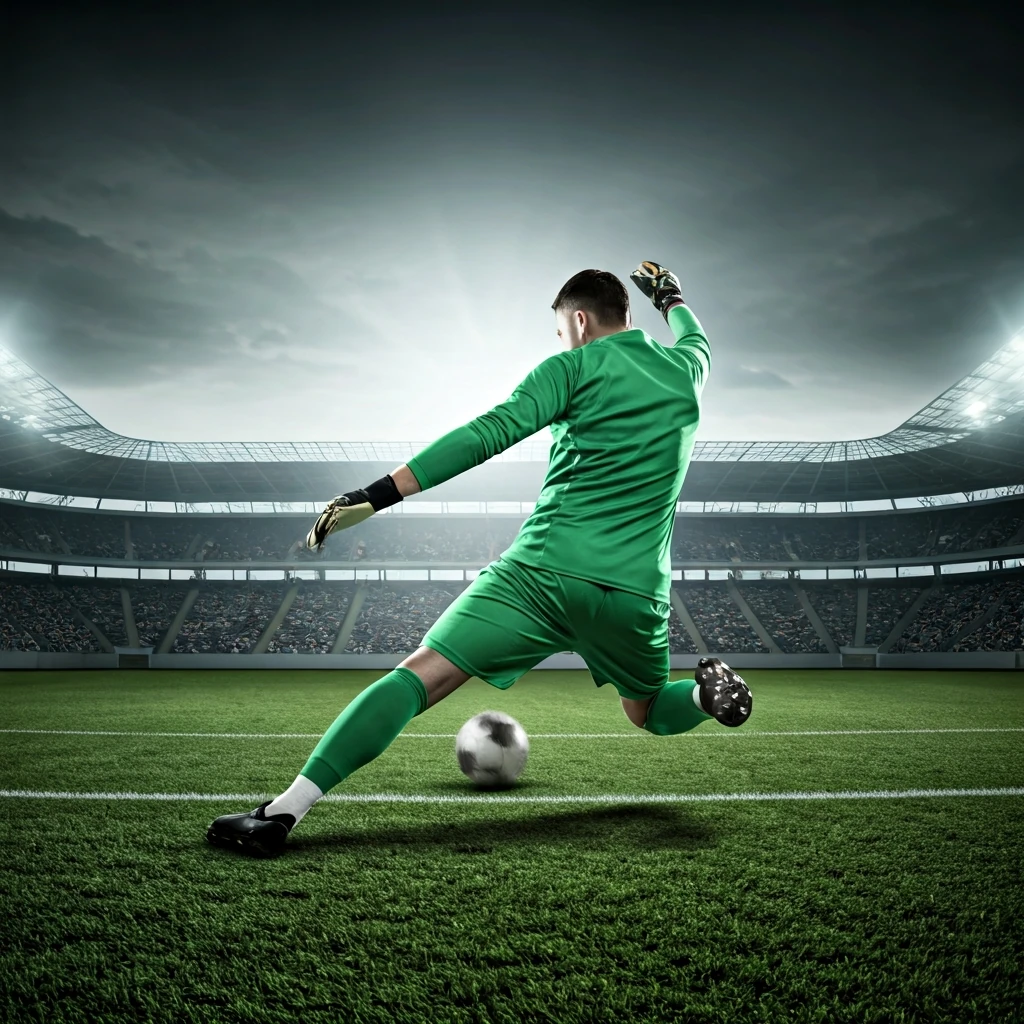
The goalkeeper dive is the iconic image of the position, the spectacular save that brings the crowd to its feet. To execute it perfectly, the secret lies in the lateral push, launching your body toward the ball off the nearest leg. Your leading hand should go firmly to the ball, while the other offers support and balance, ensuring the rebound isn’t a gift for the opponent.
The landing is as important as the leap. The correct rolling technique, absorbing the impact with the side of your body — hip, torso, and shoulder — protects against injury and allows a quick recovery for a second save. Specific Physical Training for Soccer Athletes strengthens the core and stabilizing muscles, essential for safe, explosive landings.
Coming Off the Line: The Right Moment and Anticipation
The decision to leave your goal line is one of the most critical a goalkeeper can make. A successful rush off the line thwarts a clear attack, but a miscalculation results in an easy goal. The key is reading the game: anticipating the ball’s trajectory and the opponent’s intention, acting with confidence and speed to narrow the attacker’s angle.
Coming for High Balls
On crosses and corners, the goalkeeper owns the six-yard box. Coming out for high balls requires the courage to face traffic, perfect timing, and a commanding shout. Good Communication on the Field: The Key to Success, with a loud “KEEPER!”, clears the way and commands respect, allowing you to rise with your protective knee up and catch the ball at its highest point.
Diving at the Attacker’s Feet
The one-on-one is the ultimate test of nerve and technique. When coming out at the attacker’s feet, the goal is to reduce their space and time to shoot. The approach should be fast and low, using the “starfish” (spread) technique to maximize the blocking area with your body. This brave action depends on quick Tactical Analysis in Brazilian Soccer to identify the exact moment to leave the goal and smother the play.
The Penalty Challenge: Mental and Technical Strategies
Saving a penalty is a psychological game within soccer, where all the pressure is on the kicker. Use that to your advantage by moving along the line, looking the opponent in the eye, and projecting unshakable confidence. A quick look at the kicker’s history can provide clues about their favorite corner, but instinct, trained to exhaustion, is often your best guide.
Mental preparation is fundamental, and Sports Psychology in Soccer offers tools to stay calm and focused. When the kick comes, pick a side with conviction and make an explosive dive, covering as much space as possible. Even if you don’t guess the right corner, your stance can push the attacker into a mistake, proving that the presence of a great goalkeeper can decide a match before the ball is even kicked.
Communication and Leadership: The Voice of the Box
A silent goalkeeper is a team sold short. Your privileged position, with a full view of the field, makes you the true commander of the defense. Goalkeeper communication isn’t an extra; it’s a fundamental obligation that separates the good from the legendary. You’re the one who anticipates plays, adjusts positioning, and commands respect in the six-yard box.
Failing to direct your defenders is handing the advantage to the opponent. Your voice needs to be a tool as sharp as your reflexes. Ignoring this responsibility means accepting chaos in your defense and inviting the opposing attack into your goal. A lack of leadership in goal is the shortest path to defeat.
Signals and Commands: How to Guide the Back Line
Stop shouting aimlessly. Your commands should be short, clear, and decisive to organize the defense efficiently. Orders like “step up!”, “close the middle!”, “press!”, or “keeper’s ball!” should be instantly understood by your teammates. Developing this common language is essential, a topic explored in depth in studies on Communication on the Field: The Key to Success.
In addition to shouting, use hand signals to indicate how to set up the wall, the position of an unmarked player, or the direction of cover. An effective communication system turns a collection of defenders into a cohesive, impenetrable unit. This organization is the first line of defense, often more important than the save itself.
Leading by Example: Posture and Attitude
Shouting isn’t enough if your posture doesn’t command respect. True leadership in goal is shown through attitude. A goalkeeper who comes off the line with conviction to claim a cross, who doesn’t hesitate in a one-on-one, and who stands firm after a mistake inspires confidence in the whole team. Your courage is contagious.
Your body language says it all; slumped shoulders and hesitation convey fear, while an upright stance and focused gaze show you’re in control. A goalkeeper’s mindset is a pillar for the team, and Sports Psychology in Soccer offers tools to strengthen that mental fortress. Lead by example, and your defense will follow you into any battle.
Specific Training: Tools and Routines for Goalkeepers
Want to be a wall? Then get ready to put in real work. Talent gets you on the field, but it’s a disciplined training routine that turns you into a legend between the posts. Without a plan and the right tools, you’ll be just another ordinary goalkeeper waiting for the ball to arrive.
The difference between an ordinary save and an impossible one lies in obsessive preparation. Goalkeeper-specific training attacks your weaknesses and enhances your strengths, building reflexes, strength, and confidence. This is where the game is won, long before the opening whistle, through repetition, sweat, and absolute focus.
Warm-Up and Stretching: Injury Prevention
Skipping the warm-up is asking to get hurt. Before any intense activity, your body needs to be ready for the impact and explosiveness the position demands. Start with light jogging and joint movements to increase circulation and body temperature, preparing your muscles for the effort.
Next, invest in dynamic stretches that mimic in-game movements. Leg swings, torso rotations, and lateral shuffles activate the right muscle groups and increase flexibility. This not only prevents injuries but also improves your range of motion to reach difficult balls.
Ball Drills: Focus on Repetition and Precision
Repetition is the mother of perfection for a goalkeeper. The more you practice a situation, the more your brain and body learn to react automatically. Goalkeeper equipment like cones, hurdles, and rebounders is essential for creating realistic game scenarios and forcing constant adaptation.
Working on Crosses
Commanding your box on crosses intimidates any attack. Place cones to mark the six-yard box and ask a teammate or coach to send in crosses at different heights and speeds. Focus on your timing, the decision to punch or catch, and your Communication on the Field: The Key to Success with your defenders.
Point-Blank Shots
Here, reaction speed is the only law. Use cones to mark out a small area and practice saving close-range shots, forcing quick reactions with your hands and feet. Using a rebounder (rebound wall) is excellent for simulating unexpected deflections, forcing you to get up and react in fractions of a second.
The Importance of Strength and Power Training
Agility without strength doesn’t win games. A goalkeeper needs power to jump higher, speed to cover the goal, and core strength to stay stable in aerial duels. Physical Training for Soccer Athletes is an indispensable complement, focusing on exercises that build explosive power.
Include plyometric exercises in your routine, like box jumps and jump squats, to improve your spring. Medicine ball work strengthens your torso for longer, more powerful throws. Remember: a strong body is the armor that supports your technical skills and keeps you in one piece throughout the season.
The Winning Mindset: Goalkeeper Psychology
A goalkeeper’s greatest save happens inside their own head. Being physically fit is useless if your mind crumbles at the first mistake or the first boos. Goalkeeper confidence is the foundation of everything, an invisible armor that intimidates attackers and inspires the defense, and it needs to be cultivated every day.
Conceding a goal is part of the game; letting it destroy you is a choice. Mental resilience under pressure in goal separates the great goalkeepers from the good ones. It’s about having a short memory for mistakes and total focus on the present, turning frustration into fuel for the next miraculous save that brings the stadium to its feet.
This mental fortitude is built through training and self-awareness, a field just as vital as the pitch itself. Mastering goalkeeper psychology involves visualization techniques, breathing control, and absolute concentration on every second of the match. Diving deeper into topics in Sports Psychology in Soccer can provide the tools you need to armor your mind against adversity.
Game Analysis and Continuous Improvement: Sharpening Your Vision
The game doesn’t end at the final whistle; for the elite goalkeeper, it’s just beginning. True improvement happens off the field, with obsessive goalkeeper game analysis and a commitment to constant improvement. Understanding what happened on the field is the first step toward making sure mistakes aren’t repeated and that what went right becomes instinctive.
The ability to dissect a match, both your own performance and the behavior of your opponents, is what separates the good from the legendary. This studious mindset allows you to improve your vision, anticipating plays before they even develop. It’s mental work that complements all the physical effort put in during training.
Studying Opponents and Shooting Patterns
You need to become a soccer detective. Before each match, study the attackers you’ll face, observing their favorite moves, dominant foot, and finishing patterns. Analyze free-kick and penalty takers, looking for any clue that might give you a millisecond’s advantage when it’s time to make the save.
This detailed preparation is a fundamental part of modern Tactical Analysis in Brazilian Soccer, turning luck into probability. By recognizing an attacker’s tendency to shoot across goal in a given situation, you’re already one step ahead. This game intelligence is a weapon just as powerful as sharp reflexes.
Self-Evaluation and Feedback: Growing With Every Match
Being honest with yourself is the golden rule of goalkeeper development. After every game, be your own toughest critic, but also recognize what you did well. Constant self-evaluation, combined with outside feedback, creates a powerful growth cycle that prevents stagnation.
Using Video for Analysis
Record your matches and training sessions whenever possible. Watching your own performance on video is a revealing tool, exposing flaws in positioning, reaction times, and decision-making that go unnoticed in the heat of the moment. Analyze not only the goals conceded, but also the saves you made, looking for ways to further optimize your technique.
Dialogue With Coaches and Trainers
Open communication with your coaching staff is vital. They offer an outside, experienced perspective you may not have. Discuss your perceptions, listen to constructive criticism, and work together to create an individualized development plan. This exchange is an extension of Communication on the Field: The Key to Success, applied to your personal growth.
Adapting to Current Trends in Soccer
Soccer never stops evolving, and the goalkeeper position evolves with it. Today, goalkeepers are expected to be much more than just defenders of the goal, acting as a sweeper and actively participating in building plays. This requires refined footwork and an even more sophisticated reading of the game.
Staying on top of these new demands and adapting your training is crucial. Continuous goalkeeper development involves adding new skills to your repertoire, from accurate passing to the ability to play out from the back under pressure. This means Physical Training for Soccer Athletes also needs to be adjusted to develop the agility and technique needed to command the modern box.
Conclusion: More Than a Goalkeeper, a Pillar of Victory
We’ve reached the end of this guide, but your journey as a goalkeeper is just beginning. The art of defending the goal transcends simple technique; it’s a fusion of tactical intelligence, mental strength, leadership, and a tireless dedication to improvement. We’ve seen that the modern goalkeeper is a complete athlete whose influence extends across the entire field, from the first buildup play to the final organization of the defensive line.
Remember that each pillar discussed — from the fundamentals of positioning to the psychology of saving a penalty — is connected. There are no shortcuts. Exhaustive repetition in training turns technique into instinct, assertive communication turns the defense into a cohesive unit, and mental resilience turns pressure into fuel. Embrace every mistake as a lesson and every save as confirmation of your progress. Keep studying the game, taking care of your body, and, above all, cultivating the confidence that you are your team’s wall.
Frequently Asked Questions About Goalkeeper Training
What’s the best age to start training as a goalkeeper?
There’s no single ideal age, but many experts recommend starting goalkeeper-specific training around ages 8 to 10. At this stage, children have already developed basic motor skills and can begin learning the fundamentals of the position, like handling and positioning, in a playful way. The most important thing at the start is to cultivate a love for the position and the sport.
What kind of goalkeeper gloves should I use?
The choice of glove depends on your experience level and the type of field. For beginners, training gloves with synthetic latex palms are a good option because they offer greater durability. More advanced players should look for match gloves with natural latex palms for better grip, and cuts (like roll finger or negative) that fit their hands well.
How can a goalkeeper improve their distribution with their feet?
Improvement comes with constant, intentional practice. Include short and long passing drills in your routine, aiming at specific targets to sharpen your accuracy. Playing small-sided games also forces quick decision-making and improves ball control under pressure, simulating real game situations.
Is it possible to train reflexes without a dedicated coach?
Yes, absolutely. One of the most effective ways is to throw a reaction ball or a tennis ball against a wall, since its unpredictable bounces force quick reactions. You can also ask a friend to shoot or throw balls at you from close range, focusing on responding as quickly as possible with your hands and feet.
What are the most common mistakes beginner goalkeepers make?
The most frequent mistakes among beginners include poor positioning, especially not staying on the bisector of the shooting angle, and incorrect hand technique, resulting in dangerous rebounds. Other common mistakes are hesitating when coming off the line, whether on crosses or at the attacker’s feet, and struggling to recover mentally after conceding a goal.