Anúncios
Being a goalkeeper means carrying the weight of a nation in your gloves; it means being the unlikely hero or the villain in a split second. For many young players, wearing the No. 1 jersey is a dream fueled by the adrenaline of an impossible save and the glory of securing the win. But behind every spectacular leap and every commanding shout lies a path of dedication, technique and unshakable mental strength that few people know about. The loneliest position on the field is also one of the most complex and fascinating in sports.
Long gone are the days when the goalkeeper was just a shot-stopper. The evolution of soccer has turned the guardian of the net into a key piece in the tactical strategy of any top team. The modern goalkeeper is a sweeper, the team’s first playmaker, requiring not only sharp reflexes but also above-average game intelligence and a skill with the feet that was once unthinkable. This transformation demands a complete athlete, prepared to influence the game both defensively and in building attacking plays.
Anúncios
This essential guide for soccer goalkeepers is your ultimate manual for development. We’ll dive deep into every aspect that makes an elite goalkeeper. We’ll cover everything from crucial technical fundamentals, such as positioning and handling, to specific training to develop agility, reflexes and explosive power. We’ll also explore the psychology behind the position, the importance of leadership, modern techniques for playing with your feet and how to choose the right equipment to maximize your performance and safety. Get ready to begin your journey and transform your performance between the posts.
The Crucial Role of the Modern Goalkeeper: Beyond the Saves
Think being a goalkeeper is just about parrying shots? Think again. The position has evolved dramatically, turning the guardian of the net into a fundamental piece in building play. The modern goalkeeper is no longer just a reactive player; he’s an initiator, a sweeper with gloves who dictates the start of attacking plays.
Anúncios
His role goes far beyond preventing goals, involving a sharp reading of the game and surgical precision in passing. Today, the ability to play out from the back with the feet is as valued as a spectacular save. The goalkeeper’s role has become a tactical extension of the coach on the field, demanding an understanding that goes deep into Tactical Analysis in Soccer.
This transformation demands a complete athlete, with agility, strength and a sharp mind to make decisions in fractions of a second. The importance of the goalkeeper has grown to the point of setting a team’s tempo and strategy from its own goal. He is the first line of attack and the last line of defense, a true pillar of the sport.
Technical Fundamentals: The Foundation of an Exceptional Goalkeeper
Having cat-like reflexes is useless if you don’t know where to be. Goalkeeping fundamentals are the foundation that distinguishes an average player from a legend. Mastering these skills isn’t optional; it’s the essence of the position, allowing you to make impossible saves with consistency and authority.
Strategic Positioning: Where and How to Set Up
The secret of goalkeeper positioning lies in geometry, in the famous “bisector.” You always need to be on the imaginary line that splits the angle between the ball and the two posts. This maximizes your coverage and forces the shooter to aim for the toughest corners, drastically reducing the opponent’s chances of scoring.
Your body posture is equally crucial, acting as a trigger for action. Stay on the balls of your feet, with your knees slightly bent and your body leaning forward, ready to explode in any direction. This readiness isn’t just physical; it connects directly with reading the game, a key concept in Tactical Analysis in Soccer.
Catching and Diving Techniques: Safety and Efficiency
The perfect catch absorbs the ball’s impact like a cushion, turning a missile into something harmless. Hands in a “W” or “cup” shape behind the ball are the safest goalkeeping techniques for shots straight at you, ensuring it doesn’t slip away. The goal is to have “glue hands,” conveying confidence to your entire defense and frustrating the attack.
Diving isn’t about throwing yourself around any old way; it’s a controlled attack on the ball. An efficient dive involves using momentum to reach the farthest point and landing in a way that protects your body and allows you to get up quickly. That explosiveness depends on a strong core, something developed with good Strength Training for Athletes.
Mastering these techniques takes repetition to the point of exhaustion, turning conscious movements into automatic reflexes. The confidence to execute a risky dive or hold on to a powerful shot comes from both physical and mental practice, an area explored by Sports Psychology in Soccer. Every well-executed save begins long before the shot.
| Area of Focus | Key Points for Development |
|---|---|
| Technical Fundamentals | Master positioning on the bisector, ‘W’ catching technique and safe diving. |
| Physical Training | Reflex exercises, agility circuits and explosive strength training (plyometrics). |
| Mental Aspects | Develop leadership through communication, stay focused and build resilience after mistakes. |
| The Modern Game | Improve aerial command when coming off your line and your skill with your feet for building play. |
| Equipment | Choose the right gloves, cleats and padding to ensure safety and performance. |
Specific Training: Boosting Reflexes and Agility
You can’t stop anything standing still. To be a brick wall, goalkeeper training needs to go beyond basic saves, focusing on turning your body into a spring ready to explode. The difference between a spectacular save and a goal conceded lies in the milliseconds you gain through dedicated training. This is where good goalkeepers separate themselves from legendary ones.
Developing Reflexes: Reacting in Milliseconds
Reflexes aren’t luck; they’re pure training, repeated to the point of exhaustion. The ability to react to an unexpected deflection or a point-blank shot is what defines an elite goalkeeper. The goal is to shrink the time between seeing the ball and moving your body, turning reaction into an almost supernatural instinct, a direct connection between perception and action that Sports Psychology in Soccer helps sharpen.
Ball Drills and Reacting to Stimuli
To sharpen this skill, reflex drills are crucial and should be varied to simulate the unpredictability of the game. Use reaction balls, which bounce in random directions, or have a partner shoot with deliberate deflections off small obstacles. Another effective technique is using smaller balls, such as tennis balls, to improve hand-eye coordination at top speed.
- Close-range shots: Force the goalkeeper to react with his whole body in fractions of a second, with no time to think.
- Rebound walls: Kick the ball against a wall and get set to save the unpredictable return.
- Visual/audio cues: A coach points or shouts a direction at the moment of the shot, forcing quick adaptation and eliminating anticipation.
Agility and Coordination: Moving Between the Posts
A quick goalkeeper isn’t just one who dives far, but one who moves efficiently within the goal. Goalkeeper agility is about precise footwork, sharp changes of direction and the ability to always be balanced and ready for the next play. Every inch of the goal needs to be covered with short, explosive steps, not desperate movements.
Cone Circuits and Agility Ladders
Circuits are the perfect laboratory for developing this lateral and forward movement. Agility ladders improve stride frequency and coordination, while cone circuits simulate the movements needed during a match. The key is to perform the drills at maximum intensity with a focus on correct posture, keeping your center of gravity low.
- Cone slalom: Quick lateral movement while keeping your body facing forward, simulating tracking a play.
- Cone “box”: Moving forward, to one side, backward and to the other side, always in a ready stance.
- Agility ladder: Stride variations (one foot per square, two feet, lateral hops) to activate the muscles and refine footwork mechanics.
Explosive Power: Spring and Jumping
Reflexes and agility are useless if you lack the power to reach the ball. Explosive power is the engine that drives your jumps and dives, allowing you to reach shots into the top corner or tip away a ball that seemed unstoppable. This type of power is different from brute strength and requires dedicated training to be unleashed at exactly the right moment.
Plyometric exercises are the foundation for developing this ability, teaching your muscles to generate maximum force in the shortest possible time. Think box jumps, jump squats and lateral jumps over small hurdles. Integrating these routines into a Strength Training for Athletes plan ensures complete, safe development, preventing injuries and maximizing performance.
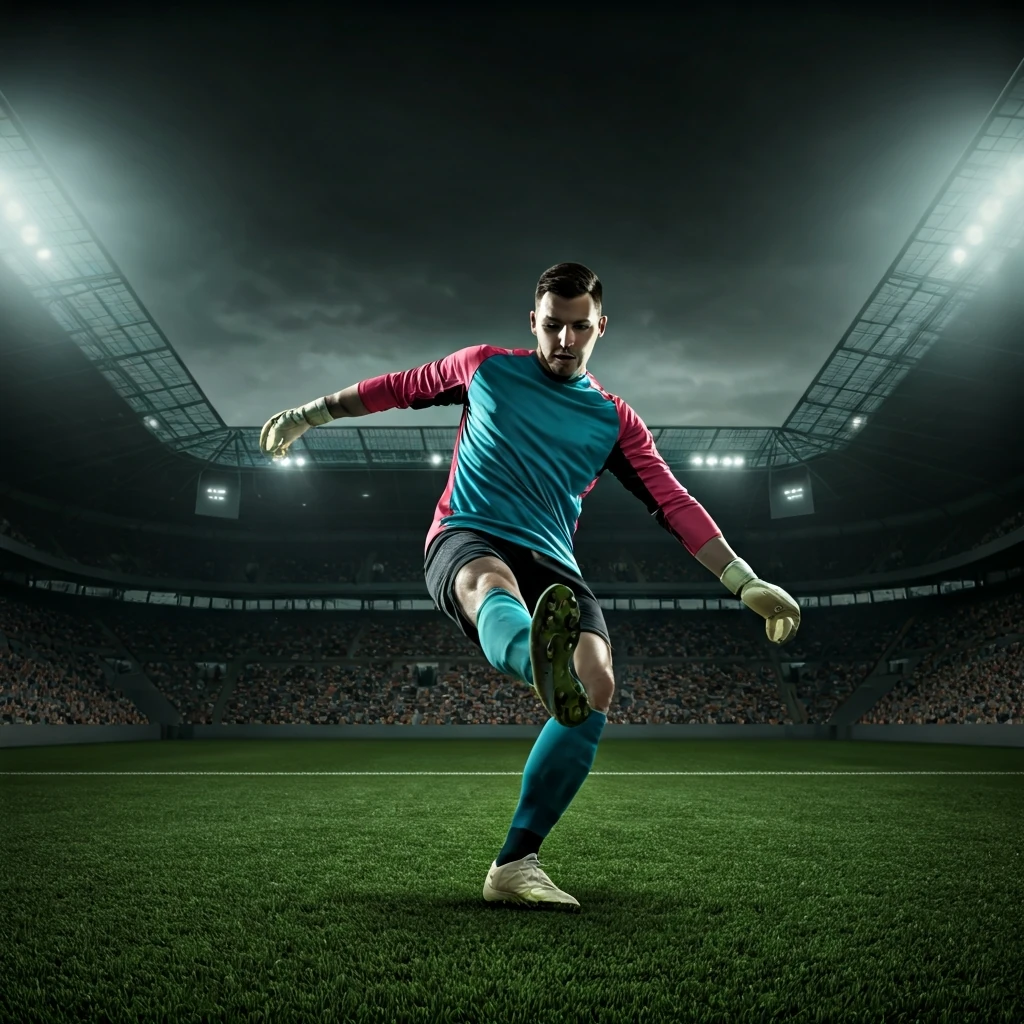
The real defense happens inside your mind.
Being the No. 1 is a constant psychological battle. While physical training shapes the body for spectacular saves, it’s mental strength that separates good goalkeepers from legends. Goalkeeper psychology is a pillar as fundamental as agility, requiring a unique combination of command, calm and courage to own the box.
Developing Leadership and Communication in the Box
You have a privileged view of the field, seeing what no other player can. Use that to your advantage. Leadership starts with clear, decisive communication, organizing the back line, warning about opponents’ movements and commanding the box on set pieces. Your voice should be a tactical tool, conveying confidence and order to the whole team.
Effective communication goes beyond random shouting; it requires a tactical understanding of the game. Being a vocal leader means directing the positioning of your center backs and fullbacks, acting like a coach on the field. This kind of command benefits directly from studying Tactical Analysis in Soccer, turning your instructions into real defensive advantages.
How to Stay Focused and Resilient Under Pressure
The game can go minutes without you touching the ball, but your mind can’t switch off. Maintaining concentration in soccer is a unique challenge for goalkeepers, who need to be ready to act in a split second. Develop mental routines, such as adjusting your gloves or touching the posts, to stay connected to the game and alert to any threat.
Failing is inevitable, but falling apart is a choice. Resilience is your ability to concede a goal and, on the very next play, be mentally whole enough to make the save of the match. Digging into concepts from Sports Psychology in Soccer helps build a strong “mental muscle,” allowing you to process a mistake instantly and bring your focus back to the present, which is the only thing you can control.
Coming Off the Line: Aerial Command and Playing with the Feet
Staying on your line is for amateurs. The modern goalkeeper owns the box and imposes himself across the whole field, a fundamental piece in both defense and attack. Mastering coming off the line, whether in the air or with the feet, separates good goalkeepers from those who win championships.
Techniques for Claiming High Balls: Anticipation and Safety
A ball lofted into the box is an invitation to chaos, and you’re the one responsible for restoring order. The decision to come or stay has to be made in a split second, based on the ball’s flight, the attackers’ positioning and your confidence. For a safe claim, the technique is clear: attack the ball at the highest point possible, always raising one knee for protection against collisions with other players.
That explosiveness to get there before everyone else doesn’t come out of nowhere. It’s built through a lot of targeted physical work. A good Strength Training for Athletes program is essential for developing the power needed to jump and dominate the airspace, ensuring you arrive at the play with authority.
The Importance of Reading the Game for Interceptions
Anticipating a cross is pure game intelligence. It involves watching the posture of the player about to deliver the ball and the attackers’ runs, and identifying the space that’s likely to be attacked. This predictive ability turns a difficult save into a comfortable interception, frustrating the opponent’s attack before it even materializes.
This skill is the practical application of Tactical Analysis in Soccer at its most individual level. By understanding the opponent’s patterns, you stop merely reacting and start dictating what happens in your box. It’s a mental game that demands concentration and deep knowledge of the match’s dynamics.
The Sweeper-Keeper: Playing with the Feet and Building Play
The era of the goalkeeper who only knows how to hoof the ball upfield is over. Today, a goalkeeper who is skilled with his feet is a powerful tactical weapon, acting as a “sweeper-keeper.” He offers a safe passing option for center backs under pressure, helps keep possession and is the first man in building the team’s attacking plays.
Short and Long Passing: Precision in Distribution
Being a good passer doesn’t just mean kicking hard. It’s about having the precision to find a free teammate, whether with a short pass that breaks the first line of pressure or with a long, accurate ball that launches a lethal counterattack. Practicing your passing technique with both feet is a differentiator that puts you on another level.
Communication: The Key to Good Chemistry with the Defense
Coming off your line without communicating is a recipe for disaster. Your center backs need to trust you, and that trust is built through clear, constant communication. The shout of “KEEPER!” should be loud and firm, leaving no doubt about who owns the ball, while quick instructions help the defense get organized.
Essential Equipment: Protection and Performance
Your equipment is your armor, not a fashion accessory. Goalkeeper gloves are the centerpiece of that arsenal, the extension of your hands and your will. Choosing the right pair, with the cut and palm suited to your playing style, is the first step toward owning the box and frustrating attackers.
But goalkeeper equipment goes far beyond gloves. Cleats with the right studs provide the explosiveness to come off your line and the stability not to slip at the decisive moment. Protective clothing, such as padded pants and jerseys, absorbs the impact of dives, allowing you to throw yourself fearlessly into every 50-50 ball.
Don’t skimp on your safety and performance; that’s pure amateurism. Low-quality goalkeeper gear can fail at the crucial moment or fail to provide the protection needed against bruises. Treat your kit as a direct investment in your career and in your ability to make game-changing saves.
Performance Analysis and Continuous Improvement
Think training is just about stopping shots? The real game starts afterward. A goalkeeper’s development doesn’t just happen during the 90 minutes or in training. The real transformation happens in goalkeeper performance analysis, a process that separates amateurs from the professionals who actually get somewhere.
Understanding where you got it right and, above all, where you got it wrong is the secret to not repeating the same mistakes. Failing to analyze your own game is the fastest path to stagnation. The pursuit of goalkeeper development is work that never ends, done both on and off the field.
Tools and Methods for Effective Self-Assessment
Technology is your greatest ally here, so make the most of it. Recording your training sessions and games is essential for brutally honest self-assessment. Watch the replays and pause at crucial moments: was your positioning correct? Was coming off your line the best decision? Write everything down in a performance journal to identify patterns.
Don’t be fooled by the spectacular saves alone; look for the small mistakes almost nobody sees. A wrong step, a moment of hesitation or a poor distribution can be the origin of a goal conceded. This process of self-criticism is a pillar of Sports Psychology in Soccer, strengthening your mind to handle pressure and focus on constant improvement.
The Importance of Feedback from Coaches and Teammates
You can’t see your own game from every angle; it’s impossible. That’s why training feedback from your coaches is pure gold. They have the technical knowledge to correct details in your form, positioning and decision-making that you’d never notice on your own, so listen closely.
Your teammates, especially the center backs, are also a valuable source of information. They feel firsthand the impact of your communication and your presence in the box. Exchanging ideas with them not only improves your game, but also deepens your understanding of Tactical Analysis in Soccer as applied to defending, creating a solid, confident defensive unit.
Physical Preparation and Nutrition: The Goalkeeper’s Athletic Body
Think talent alone is enough? Your body is your greatest weapon and work tool. Elite goalkeeper physical preparation, combined with impeccable nutrition, is what separates the good from the legendary and ensures longevity in the position. Without a body prepared for impact and explosiveness, your technique and your mind simply can’t keep up with the pace of a high-level game.
Soccer conditioning for a goalkeeper goes far beyond running laps around the field. It requires a scientific approach that builds a complete athlete, capable of reacting in fractions of a second and handling the load of training and games. This directly affects confidence, a pillar of Sports Psychology in Soccer, because a strong body supports a strong mind.
Strength and Endurance Training for the Position
Muscles aren’t just for looks; they’re the source of your explosiveness to reach impossible balls. A goalkeeper-focused Strength Training for Athletes program develops the power needed for vertical and lateral jumps, as well as the strength to hold powerful shots. The goal isn’t volume, but functionality and the ability to generate force quickly.
Specific Exercises for the Upper and Lower Body
For the lower body, exercises such as jump squats, lunges and box jumps are fundamental for building explosive leg drive. That leg strength is the engine behind every acrobatic save and quick rush off the line. The speed of your feet starts with the strength of your legs.
For the upper body and core, the focus is on stability and grip strength. Medicine ball throws, plyometric push-ups and pull-ups strengthen the arms, shoulders and back, preparing you to punch balls clear and claim crosses with authority. A strong core is the bridge that efficiently transfers energy from your legs to your hands.
Injury Prevention: Warm-Up, Stretching and Recovery
Being a durable athlete isn’t a matter of luck, but of discipline and intelligence. Injury prevention starts long before the opening whistle, with a dynamic warm-up that prepares your muscles and joints for the intensity of training. Skipping this phase is asking for strains and problems that can sideline you for weeks.
Post-Training and Post-Game Recovery Strategies
What you do after training is as important as the training itself. Strategies such as ice baths, foam rolling and, above all, a good night’s sleep are essential for muscle repair. Recovery is when your body rebuilds itself stronger, allowing you to return to the next session at 100%.
The Goalkeeper’s Diet: Fuel for High Performance
Your body is a high-performance machine, and it needs the right fuel to run at full capacity. Proper athlete nutrition provides the energy for intense training and the raw material for muscle recovery. For a detailed guide, explore the principles of Nutrition for High-Performance Athletes.
This translates into a diet rich in complex carbohydrates for sustained energy, lean proteins to repair muscles and healthy fats for hormonal function. Hydration is another non-negotiable, since dehydration directly affects your reaction time, focus and decision-making. Eating well isn’t optional; it’s a requirement for anyone who wants to reach the top and stay there.
The Goalkeeper’s Journey: A Commitment to Excellence
Mastering the art of goalkeeping is a marathon, not a 100-meter dash. As we’ve seen in this guide, the position demands a complex combination of technical skill, explosive fitness and, perhaps most importantly, mental fortitude. From geometric positioning and safe hands to leadership in the box and precision with the feet, every detail counts. Remember that improvement is continuous and the pursuit of perfection never ends. Record your games, analyze your mistakes, celebrate your saves and, above all, never lose your passion for being the last line of defense and the first line of attack. Greatness awaits those who dedicate themselves every day.
Frequently Asked Questions About the Goalkeeper Position
What is the best age to start training as a goalkeeper?
There’s no magic age, but specialization usually begins between 10 and 12 years old, after a foundation of motor coordination has been built. Most important is that the child shows interest in and passion for the position, since the journey requires a great deal of mental and physical dedication.
How many times a week should a goalkeeper train?
For a developing goalkeeper, the ideal is 2 to 3 position-specific sessions per week, in addition to activities with the rest of the team. This volume allows technique to improve without excessive wear, and it’s crucial to balance effort with rest for muscle recovery and injury prevention.
What are the most common mistakes beginner goalkeepers make?
Beginners often get basic positioning wrong, are afraid to attack the ball and don’t communicate with the defense, creating insecurity. Another classic mistake is poor catching technique, which results in lots of rebounds, along with difficulty staying focused for the full 90 minutes.
How can I improve my vision of the game as a goalkeeper?
To improve your vision of the game, study the positioning of professional goalkeepers and try to anticipate plays. During training, force yourself to constantly look around to map where opponents and teammates are, making reading the field a habit.
Is it possible to be a good goalkeeper without being very tall?
Absolutely. Height is an advantage, but it’s not a prerequisite for being an elite goalkeeper. Shorter goalkeepers can compensate with exceptional agility, sharp reflexes, quicker reaction time and a powerful leap, as great names in world soccer have proven.