Anúncios
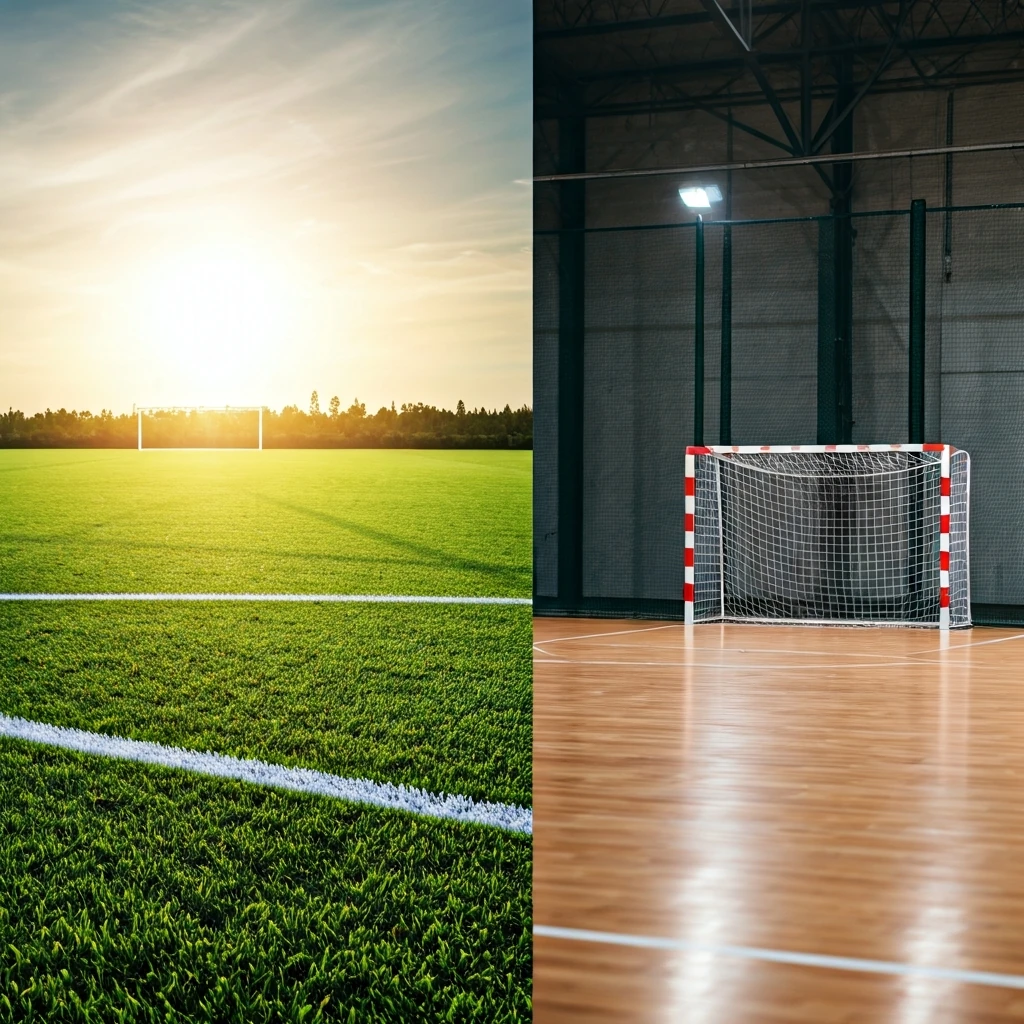
Outdoor soccer or futsal? For many, the answer seems obvious, but the truth is that both sports, although cousins at heart, represent completely different tactical and technical worlds. The eternal debate over which format is “better” or more challenging misses the main point: their differences are actually their greatest complementary strength. While one takes place on vast grass fields under the open sky, the other is a battle of agility fought on compact courts, where every second and every inch counts. This fundamental divergence produces athletes with unique skills and opposite views of the game.
The origin of each already reveals its philosophy. Outdoor soccer, born on the fields of England, was designed for space, endurance and long-term strategy. It is a physical game of chess, where occupying territory and the ability to cover long distances are crucial. By contrast, futsal is a South American invention, a creative response to the lack of space in Uruguay’s urban centers. Its soul lies in quick thinking, flawless ball control and improvisation, turning the court into an intensive laboratory of pure technical skill.
Anúncios
This article dives deep into this fascinating comparison. We will analyze everything from the most basic rules that drastically change the pace of play, such as the number of players and how the ball is put back into play, to the tactical strategies shaped by the difference in space. We will explore which technical skills each format prioritizes and how combining both may be the secret to developing a truly complete athlete. By the end, you will understand not only the differences, but how the field and the court come together to tell the story of the world’s most beloved sport.
The Origins and Philosophy of Each Format
Outdoor soccer and futsal: cousins, but not siblings. Outdoor soccer, with its roots in 19th-century England, was conceived for vast grass fields, demanding stamina and strategy. Its philosophy is based on the intelligent occupation of space, the physical endurance to cover long distances and complex team tactics. This essence spread across the globe and shaped the passionate History of Brazilian Soccer.
Anúncios
In contrast, futsal is a child of urban creativity, born in Uruguay to adapt the sport to tight spaces. The philosophy here is completely different, focused on agility, quick thinking and flawless technical mastery in congested areas. It is a true skills laboratory, where improvisation and ball control reign supreme, making it an excellent foundation for any Soccer Training for Beginners.
Essential Rules: What Changes from the Field to the Court?
Think the rules are the same? Think again. Moving from grass to the court turns soccer into an almost entirely new sport, with its own rulebook that dictates a completely different pace and strategy. Ignoring these differences is the first step to understanding nothing about either one.
Number of Players and Size of the Playing Area
The most glaring difference is the battlefield itself. In outdoor soccer, 11 players per team spread out across a grass field that can exceed 100 meters in length. This vast space demands outrageous lung capacity and a panoramic view of the game, where substitutions are limited and every change is a crucial tactical decision.
In futsal, it is a different story: a head-to-head battle with just 5 players per team on a compact court. Substitutions are unlimited and constant, keeping the intensity at maximum all the time. This dynamic turns the game into pure explosiveness and agility, where a good Complete Guide to Soccer Positioning is vital for surviving the organized chaos.
Key Differences in Restarts and Fouls
The ball rolls, but how it comes back into play changes everything. On the field, the throw-in with the hands is a classic play, often used to buy time and reorganize the team. In futsal, the restart from the sideline is taken with the feet, a detail that turns a simple restart into a potential assist, demanding maximum attention.
The clock and discipline also work in opposite ways. Futsal imposes the famous 4-second rule on every set piece, punishing hesitation and speeding up the game. In addition, the system of accumulated fouls, which awards a direct free kick with no wall after a team’s fifth foul, injects a level of tension and tactical discipline that simply does not exist on the field, directly influencing defensive Modern Soccer Tactics.
| Feature | Outdoor Soccer | Futsal |
|---|---|---|
| Number of Players | 11 per team | 5 per team |
| Playing Area | Large grass field (approx. 105x68m) | Compact court (approx. 40x20m) |
| Type of Ball | Larger, lighter, with a normal bounce | Smaller, heavier, with a reduced bounce |
| Substitutions | Limited per match | Unlimited and rolling |
| Sideline Restart | With the hands (throw-in) | With the feet (kick-in within 4 seconds) |
| Key Skills | Long passing, vision, endurance | Close dribbling, agility, quick thinking |
| Physical Demands | Aerobic endurance, long runs | Explosiveness, agility, changes of direction |
| Main Strategy | Use of width and depth | Compactness, high pressing and rotation |
The Influence of Space: Adapted Tactics and Strategies
The size of the playing area defines the game. Forget everything else. The most brutal difference between outdoor soccer and futsal is not the ball or the number of players, but the available space, which forces a complete reinvention of tactical and strategic thinking in each format.
The Importance of Width and Depth on the Field
In outdoor soccer, space is a weapon. Teams exploit width with wingers staying wide to stretch the opposing defense, creating lanes to break through. Depth is used with long balls and passes in behind the back line, looking to exploit the vast area behind the defenders. Tactical formations are designed to dominate these dimensions, something fundamental in Modern Soccer Tactics.
Transitions and Counterattacks
With so much ground to cover, the transition between defense and attack is a decisive moment. A tackle in midfield can turn into a lethal counterattack in seconds, requiring explosive speed and the intelligence to fill empty spaces. Understanding how to behave in these moments is a pillar of any Complete Guide to Soccer Positioning, separating reactive teams from proactive ones.
Compactness and Constant Movement on the Court
In futsal, space is a luxury that does not exist. The strategy flips: the goal is to deny the opponent space through defensive compactness, keeping the lines close together and forcing mistakes. Movement off the ball is relentless, because standing still makes you an easy target and useless to the team, which has to create tiny openings with quick passing and smart runs.
High Pressing and Position Rotation
The small court makes the high press one of the most effective and constant futsal strategies. Since the distance to the opponent’s goal is short, winning the ball in the attacking half creates a clear scoring chance almost instantly. This leads to intense rotation of positions, where a defender (the “fixo”) can finish a move and a target forward (the “pivô”) can be defending in his own area, making fixed positions almost obsolete.
Set-Piece Strategies: Corners and Free Kicks
Set pieces in each sport are a direct reflection of their environment. On the field, a corner kick is often an aerial battle, with crosses looking for tall players in the box. In futsal, it is a high-speed chess move, with screens, short passes and low shots rehearsed to exhaustion, resembling a basketball play more than a soccer play.
Fouls also follow different logics. While on the field the wall is a central element, in futsal the accumulation of fouls leading to a direct free kick with no wall punishes indiscipline and overly aggressive defending. Mastering these nuances is vital from the very beginning and sets apart any Soccer Training for Beginners program that aims to develop complete athletes.
Technical Skills: What Does Each Format Prioritize?
Think fast or get left behind. That is the law that separates futsal from the field. While one demands brilliant improvisation in a tiny space, the other demands the strategic reading of a battlefield. The technical skills valued in each sport are a direct reflection of their distinct environments and define the type of player each one produces.
Quick Touches and Close Dribbling in Futsal
In futsal, the ball is your inseparable partner in crime. The reduced space and constant pressing force players to develop outrageous ball control, using the sole of the foot to control, shield and dribble. The speed of the game does not allow hesitation; your thinking has to be as quick as your touch, turning every play into an opportunity for a close dribble and an unexpected finish.
This mental and technical agility is what makes futsal players so dangerous when they move to the field. They learn to solve complex problems under maximum pressure, a fundamental skill in any player’s technical development. The court is a laboratory of creativity, where the ability to escape impossible situations with a touch of genius is the main currency.
Long Passing and Vision in Outdoor Soccer
On grass, the perspective changes completely. The ability to hit an accurate long pass, a switch of play that breaks down the opposing defense, is just as valuable as a bewildering dribble. Here, peripheral vision is fundamental, because the player needs to read a much larger space, anticipate movement and find teammates dozens of meters away.
Outdoor soccer values the athlete who thinks about the game collectively, who understands the rhythm and cadence of the match. Delivering a perfectly weighted cross or a long ball that puts the striker one-on-one with the keeper are expressions of sharp tactical intelligence. These actions, which define Modern Soccer Tactics, depend on the ability to see the whole picture, not just the immediate duel.
The Impact on Athlete Development: Complementary or a Choice?
Futsal manufactures geniuses. The field makes them immortal. The debate over which format is better for athlete development is an old one, but the answer is not a simple choice. The truth is that the two formats complement each other, creating more complete and versatile players who can adapt to different tactical and technical challenges.
The discussion is not about which one is superior, but about how combining the two can boost player development. Futsal at the youth level offers a set of skills that transfer directly and are extremely valuable on the field. At the same time, the field teaches lessons that the court, due to its space limitations, cannot provide.
How Futsal Improves Decision-Making and Agility
The futsal court is a laboratory of constant pressure. With reduced space and time, players are forced to think and act in fractions of a second. This intensity accelerates the development of decision-making under pressure, stimulating creativity and improvisation to find solutions in congested scenarios.
Mastery of the ball is another glaring difference. The heavier ball with less bounce requires absolute control, making touch and dribbling an extension of the athlete’s body. This ability to keep the ball glued to your foot under tight marking is one of the greatest legacies futsal gives to outdoor soccer.
Examples of Stars Developed in Futsal
The proof of futsal’s impact lies in the sport’s gallery of idols. The History of Brazilian Soccer is full of stars like Ronaldinho Gaúcho, Neymar and Robinho, whose technical foundation was forged on the court. Their close dribbling, quick thinking and ability to escape impossible situations are trademarks learned in the tight confines of the indoor game.
The Importance of Outdoor Soccer for Endurance and Positioning
When a player steps onto the grass, the dimensions of the game change dramatically. The field demands a completely different physical capacity, focused on cardiovascular endurance and the power to cover long distances. The ability to run for 90 minutes, alternating sprints and jogging, is a fundamental requirement that only the field fully develops.
Beyond the physical side, tactical intelligence off the ball takes on new weight. Understanding space, closing passing lanes and maintaining defensive organization are crucial skills, as detailed in any Complete Guide to Soccer Positioning. On the field, correct positioning is often more important than a brilliant dribble.
Benefits for Big-Picture Game Reading
Outdoor soccer teaches players to “read the game” on a macro scale. Peripheral vision and the ability to anticipate plays happening on the other side of the field are essential. This broad reading allows players to execute precise switches of play and long balls that break defensive lines, pillars of Modern Soccer Tactics.
Transitioning and Adapting Between Formats
Moving from futsal to the field is a process of adaptation. Familiarity with the ball is an asset, but the player needs to adjust the weight of passes, the power of shots and the timing for aerial balls. Handling more intense physical contact and the discipline to hold a tactical position are also common challenges.
However, the intelligence gained on the court speeds up the adaptation. The ability to find tiny spaces translates into a deadly advantage inside the penalty area, where every inch counts. Ideally, good Soccer Training for Beginners integrates fundamentals from both formats, building an extremely rich technical and tactical foundation from the start of the journey.
Equipment and Playing Surfaces: Practical Differences
Studded cleats do not go on the court. Period. The difference between the formats starts at your feet, where the studded field cleat is mandatory to provide traction on grass during sprints and changes of direction. In futsal, the shoe has a flat rubber sole, designed for maximum grip on the hard court and to make it easier to control the ball with the sole, an essential fundamental of the game.
The ball also represents a whole different world. The futsal ball is noticeably smaller, heavier and has a reduced bounce, which makes it ideal for quick control in confined spaces. This characteristic forces players to develop refined control and to prioritize short, fast passes. In contrast, the outdoor ball, larger and lighter, was made to fly on long balls and long-range shots.
The stage where the show takes place dictates the entire rhythm. Grass, whether natural or artificial, is a surface that absorbs impact and can have irregularities that alter the ball’s path. The futsal court, on the other hand, is a hard, predictable surface that rewards refined technique and mental agility, making futsal gear a direct response to this dynamic environment.
The Professional Landscape: Competitions and Recognition
Money, fame and infrastructure are not the same in the two worlds. Outdoor soccer is a global entertainment machine that moves billions and turns athletes into cultural icons. Futsal, despite significant growth and a legion of passionate fans, operates on a completely different scale, with its own challenges and opportunities for its professionals.
Major Outdoor Soccer Leagues and Tournaments
When it comes to outdoor soccer competitions, the scale is planetary. The FIFA World Cup brings nations to a standstill, while the UEFA Champions League and the Copa Libertadores represent the pinnacle for clubs. National leagues like the Premier League, La Liga and Brazil’s Brasileirão, with its rich History of Brazilian Soccer, set the pace with astronomical TV deals and sponsorships.
This robust structure creates a clear professional pathway from the youth level, something that inspires any Soccer Training for Beginners. Professional recognition is massive, with multimillion-dollar salaries and media exposure that transcends the sport. To stay at the top, it is essential to master the Modern Soccer Tactics that define the game today.
The Growth of Futsal and Its World Competitions
Futsal also shines on its own world stage, with the FIFA Futsal World Cup as the main showcase for national teams. Futsal leagues, such as Brazil’s Liga Nacional de Futsal (LNF) and Spain’s LNFS, are extremely competitive and produce world-class talent. The UEFA Futsal Champions League shows the strength of the sport in Europe, with well-organized clubs and a very loyal fan base.
Professional recognition on the court, although it does not compare financially with the grass game, is solid and growing. Many athletes make a living exclusively from the sport, especially in futsal powerhouses like Brazil, Spain and Portugal. For countless stars, the court is the first step, proving that futsal is a talent laboratory for the field.
Outdoor Soccer or Futsal: Which Should You Choose and Why?
The final decision is yours. But which path will take you to the top of your game? The choice between grass and court defines not only the type of player you will become, but also the journey you will have in the sport. Analyzing your own goals is the first step to making the right decision and not regretting it later.
Personal Goals and Sporting Aspirations
Do you dream of glory in the big stadiums and worldwide fame? Outdoor soccer is undoubtedly the main stage, offering unmatched visibility and professional infrastructure on a global scale. A career on the field is the traditional path for anyone looking to become a mass idol and compete in the most prestigious tournaments on the planet.
On the other hand, if your passion is close dribbling, quick thinking and genius in tiny spaces, futsal may be your universe. The advantages of futsal include accelerated technical development and a solid career in a sport that values pure skill. Being king of the court is just as legitimate and challenging an aspiration as being a star on grass.
Developing Specific Skills
For those just starting out, futsal works as an intensive talent laboratory, forcing players to sharpen their ball control, quick passing and decision-making under pressure. Many outdoor stars started on the court precisely to polish this fundamental technical foundation. Good Soccer Training for Beginners usually incorporates elements of both formats to create a more complete athlete.
Considerations About Age and Skill Level
For children and young people, futsal is often the ideal gateway into the world of soccer. The reduced space and greater contact with the ball ensure more dynamic and fun learning, building confidence and familiarity with the ball. It is a solid foundation before making the transition to the larger dimensions of the field.
For adults who are starting out or returning to the sport, futsal can be less physically intimidating, requiring fewer long sprints and focusing more on explosiveness and agility. Outdoor soccer, in turn, demands more robust fitness and cardiovascular endurance to cover the long distances of the field.
Playing Both and Its Benefits
The best answer to the question of which form of soccer to choose may not be a choice at all, but a combination. Players who move between the court and the field develop impressive tactical versatility, able to solve problems in different game scenarios. This adaptability is highly valued in Modern Soccer Tactics, which prize intelligent, versatile athletes.
Passion for the Game: The Deciding Factor
At the end of the day, technical analysis and career goals matter, but nothing beats the deciding factor: passion. Where do you feel most alive? Is it on the grass, feeling the width of the field and planning a long-range play, or on the court, with the ball glued to your foot and the sound of the crowd echoing close by? The best format is the one that makes your heart beat faster.
This choice is personal and yours alone, a reflection of your style and your soul as a player. Listen to your intuition and play where you feel happiest. After all, it is that joy that fuels the discipline and dedication needed to improve, whatever surface you choose.
Conclusion: Rivals or Allies in Developing the Complete Player?
At the end of this analysis, it is clear that the question is not “outdoor soccer versus futsal”, but rather “outdoor soccer and futsal”. The two formats are not competitors, but powerful allies in athlete development. Futsal, with its intensity, reduced space and demand for quick thinking, works as a high-performance laboratory for technique, dribbling and decision-making under pressure. It builds the familiarity with the ball that sets stars apart.
Outdoor soccer, on the other hand, teaches the language of space, endurance and large-scale tactical intelligence. It develops vision, the physical power for long distances and the positional discipline that are indispensable at the professional level. The transition between formats can be challenging, but the benefits are undeniable. Combining the mental agility of the indoor game with the strategic reading of the grass game creates a more versatile, adaptable and, ultimately, more complete player. The choice does not have to be exclusive, but a journey of integration to get the best of both worlds.
Frequently Asked Questions About Outdoor Soccer vs. Futsal
Which format is better for young beginners?
Futsal is often recommended for young beginners. The smaller court and fewer players mean that kids touch the ball much more often, speeding up the development of control, dribbling and decision-making. In addition, the more controlled environment focuses on sharpening essential technical fundamentals.
Is it possible to be good at both formats at the same time?
Yes, it is entirely possible, and many professional players are proof of that. Being good at both requires a great ability to adapt to the different physical, tactical and pace demands. The key is to understand the nuances of each sport and adjust your style of play, using the skills from one to boost your performance in the other.
Does futsal really help you get better at outdoor soccer?
Absolutely. Futsal is an exceptional development tool for outdoor soccer, sharpening quick thinking, ball control in tight spaces and the creativity to escape pressure situations. Stars like Ronaldinho and Neymar had their foundation in futsal, which highlights the format’s positive impact on technical development.
What are the most common injuries in each sport?
In outdoor soccer, muscle injuries (such as thigh strains) and ligament injuries (knee and ankle) are common due to long runs and physical contact. In futsal, the most frequent injuries are joint-related, especially in the ankle and knee, because of the quick, constant changes of direction on a hard, high-impact surface.
Which format requires more physical fitness?
Both require excellent fitness, but of different kinds. Outdoor soccer demands more aerobic and cardiovascular endurance to last 90 minutes covering long distances. Futsal requires more anaerobic power, with short sprints, muscular explosiveness and agility for the constant accelerating and braking.