Anúncios
Your team has good players, but the results just aren’t coming? The frustration of dominating a match and still walking off the field with a loss is a common feeling in amateur soccer. Often, the problem isn’t a lack of individual talent, but a series of silent, recurring mistakes that erode the team’s collective potential, turning skilled players into a disorganized, predictable group.
These mistakes go far beyond a misplaced pass or a poor finish. They are rooted in pickup-game culture, where physical preparation is neglected, communication on the field is almost nonexistent and strategy is replaced by constant improvisation. Believing that skill on the ball is enough is the biggest trap in grassroots soccer, because it ignores the pillars that support any winning team: tactical organization, discipline and emotional intelligence.
Anúncios
In this complete guide, we’ll uncover the most common mistakes that hurt your team’s performance in amateur soccer. We’ll look at everything from the importance of a game plan and correct positioning to the need for proper fitness and effective communication. By identifying these flaws and applying the practical solutions we present, you’ll be on the right track to turning a bunch of good players into a truly competitive, winning team.
The Importance of Understanding the Team Game
Is your team a bunch of stars or a real team? In amateur soccer, many believe individual talent solves everything, but that’s a classic trap. A lack of chemistry is a recipe for failure, turning skillful players into a disorganized group that’s easy to beat. Without a collective mindset, frustration on the field is practically guaranteed.
Anúncios
More Than Eleven Players: Synergy on the Field
A real team is one that plays in sync, where communication doesn’t need words and movements are coordinated. True team play in amateur soccer happens when the team works like a single machine, overcoming opponents who are stronger on paper. This synergy is built with dedication, applying good Soccer Training Tips and understanding Tactics for 11-a-Side Soccer.
That connection turns the group into a solid, confident unit. Knowing that your teammate will cover for you or that the ball will arrive at the right time lets everyone play with more freedom and security. It’s this mutual trust that raises the level of play and creates scoring chances that individual plays rarely produce.
How Excessive Individualism Hurts
Everyone knows that player who ignores their teammates to try an impossible solo run. Excessive individualism is poison for any team, because it breaks the rhythm, breeds distrust and wastes clear scoring chances. This selfish attitude not only compromises the result, it also destroys team morale.
When a player prioritizes personal glory over the group’s success, they become a problem. True amateur teamwork multiplies everyone’s talent, while selfishness cancels it out. Understanding that the collective amplifies the individual is the first step to turning a pile of players into a genuinely competitive team.
The Danger of Inadequate Physical Preparation
Do you really believe that playing only on weekends is enough to stay in shape? That’s one of the most dangerous and arrogant misconceptions in grassroots soccer. Treating your body like a machine that only needs to work for 90 minutes, with no maintenance at all, is the fastest route to the injury list. The truth is that every sprint without proper preparation exponentially increases your chances of a serious injury.
A lack of proper amateur soccer fitness doesn’t just affect your health; it destroys your performance on the field. You become the player who fades in the second half, who loses the race to the opponent and who becomes a burden to the team. Ignoring basic physical preparation is a decision that compromises not only your game but the result for the whole team, which has to make up for your lack of stamina.
The good news is you don’t need to train like a pro to see a dramatic difference. Adding simple workouts during the week changes the game and protects your body against the most common amateur soccer injuries, such as strains and sprains. Investing time in Sports Injury Prevention isn’t a luxury; it’s a necessity for anyone who wants to keep playing the game they love for a long time.
| Common Mistake in Amateur Soccer | Practical and Effective Solution |
|---|---|
| Excessive Individualism | Focus on team training, value assists and create a culture where the team’s success comes before personal glory. |
| Poor Fitness | Add 2 short weekly running and strength sessions. Always do a full warm-up before playing. |
| Tactical and Positional Disorganization | Define a basic tactical system (e.g., 4-4-2), assign clear roles and practice off-the-ball positioning. |
| Communication Breakdowns on the Field | Encourage short, clear commands (‘man on’, ‘time’, ‘mark up’). The goalkeeper and center backs should lead the verbal organization. |
| Losing Emotional Control | Practice resilience after mistakes, use breathing techniques to stay calm and focus on the next play, avoiding arguments. |
Strategy and Positioning: Beyond Individual Talent
Your team has stars but keeps losing? The problem may not be a lack of skill, but the total absence of a plan. In amateur soccer, it’s common to see a bunch of good players running around aimlessly, with individual talent trying to make up for collective disorganization. That’s a recipe for failure, because even a minimally organized opponent can easily take apart a team that relies only on flashes of brilliance and improvisation.
The Importance of a Game Plan
Having a game plan doesn’t mean creating a complex system like a professional team’s; it means defining clear objectives. Will the team press the opponent’s build-up or sit back in its own half to counterattack? Without that basic definition, every player acts on instinct, resulting in a team that neither attacks nor defends efficiently. A minimum of amateur soccer tactics turns a group of individuals into a cohesive, competitive team.
Communication is the foundation for any strategy to work, from the goalkeeper organizing the back line to the forward signaling a play. Deciding who takes free kicks, who goes up for corners and who stays back as cover are details that prevent confusion and optimize plays. Studying some basic Tactics for 11-a-Side Soccer can raise your team’s level surprisingly, ensuring everyone knows what to do with and without the ball.
Understanding Different Tactical Roles
Every position on the field has responsibilities that go beyond the obvious, and ignoring them is one of the biggest mistakes. The fullback isn’t just a winger who starts deeper; they need to know when to support the attack and, crucially, when to get back and defend. The same goes for the defensive midfielder, who can’t just be a “guard dog” in front of the back line but must also know how to start attacking moves with quality passing.
This lack of understanding of tactical roles leaves huge holes on the field. A forward who doesn’t help defend overloads the midfield, and a midfielder who doesn’t track back leaves the defense exposed. Good amateur game reading involves understanding your tactical role and your teammates’, creating a system of mutual support that strengthens every part of the team.
Common Positioning Mistakes by Area of the Field
Positioning on the field is perhaps the most neglected tactical aspect in grassroots soccer, producing errors that give games away. Many players follow the ball with their eyes, forgetting to mark their opponent or occupy the right spaces. This basic mistake is the source of most goals conceded in amateur games, where the defense looks like a sieve.
Defense: Cover and Marking
In defense, the classic mistake is “ball watching.” Two or three defenders rush toward the player in possession while opponents are left completely free in the box. The basic rule is: one player challenges and the other provides cover. A lack of communication to keep a cohesive defensive line also creates fatal gaps for the opponent to exploit with long balls.
Midfield: Transition and Creation
The midfield is the heart of the team, and its main positioning mistake is a lack of connection between defense and attack. Midfielders often push too far forward, leaving an empty space between them and the center backs, or drop too deep, isolating the forwards. A well-positioned midfielder knows when to come close to receive the ball from the defense and when to push forward to create scoring chances, keeping the team compact and dangerous.
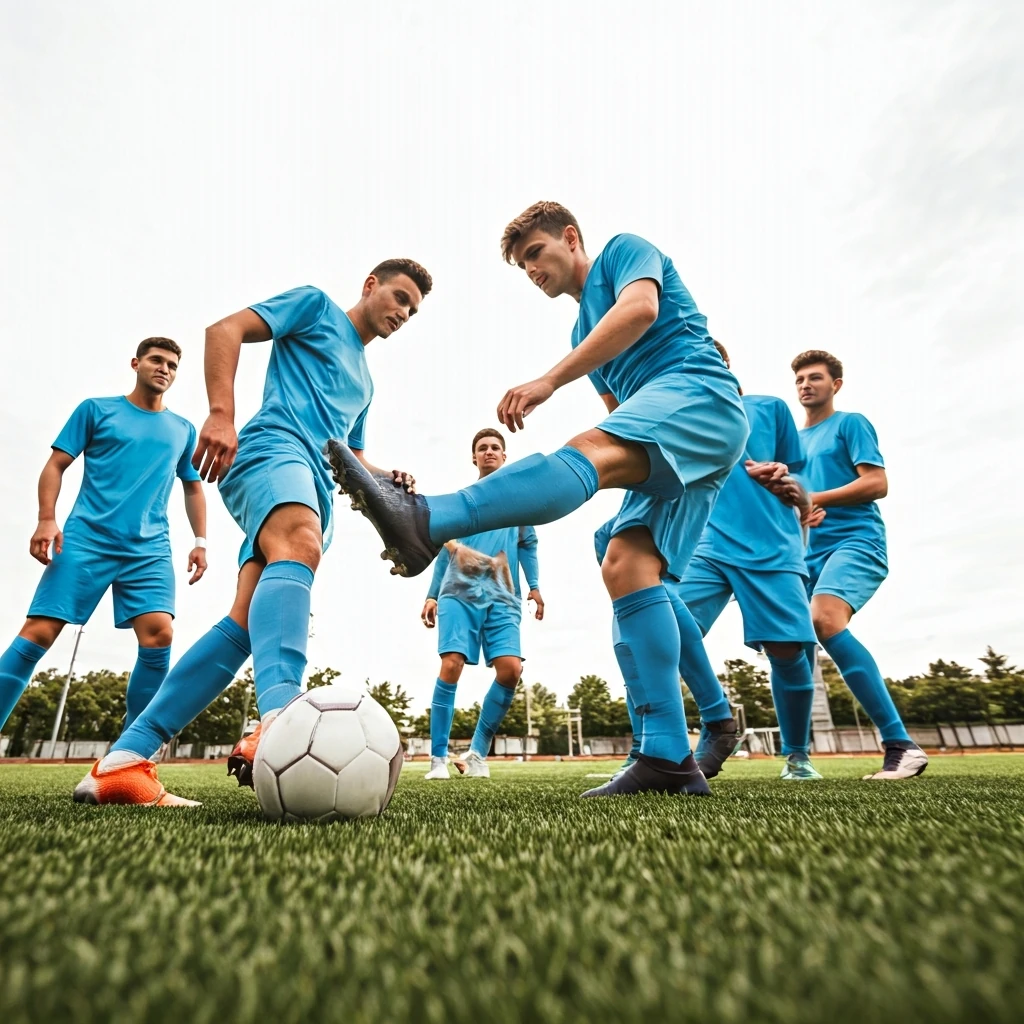
Effective Communication: The Engine of the Team on the Field
Is your team silent on the field? Then get ready to lose badly. Silence is the hidden opponent that destroys the organization of any amateur team. When communication in soccer breaks down, easy balls are lost, players collide and deadly gaps open up in the defense, making it one of the most common mistakes in amateur soccer.
Many mistakes, such as two center backs going for the same ball or an opposing forward receiving it unmarked, come from the absence of a simple shout. A team that doesn’t talk is a collection of individuals running randomly, not a cohesive unit. Improving on-field dialogue transforms collective performance immediately and visibly.
Signals, Shouts and Gestures: The Language of Soccer
The language of soccer is direct and precise; it doesn’t need frills. Short commands like “man on!”, “time!”, “switch it!” or “mark up!” are essential for verbal tactical organization. These quick warnings give the teammate on the ball information they can’t see, allowing smarter decisions in split seconds.
Beyond shouting, gestures are essential for complete communication. Pointing to the player who needs to be marked, raising your arm to ask for a ball in behind or signaling a rehearsed play are powerful tools. Mastering this nonverbal communication is an integral part of good Tactics for 11-a-Side Soccer and raises the collective level.
Overcoming Communication Barriers
Many amateur players refuse to talk out of fear of being wrong, shyness or simply lack of habit. You need to create a culture where communicating is encouraged and seen as everyone’s responsibility, from the goalkeeper to the striker. A wrong call is better than the silence that leads to an opposing goal.
The solution starts in training, where the coach or team leader should constantly demand dialogue. Encouraging players to guide each other builds trust and turns communication into a natural reflex during matches. Including this practice in your Soccer Training Tips is a crucial step toward building a truly connected team.
Poor Management of Emotions During the Match
Your head is your biggest opponent on the field. Many amateur games are decided not by technique, but by one team’s ability to keep its composure while the other explodes. Emotional control in soccer separates the players who solve problems from those who create more of them for their own team.
Frustration and Anger: Enemies of Good Soccer
A misplaced pass, a missed goal or a questionable call from the referee are the trigger for losing control. Frustration quickly turns into anger, and an irritated player makes bad decisions, goes for the solo play and forgets the team. This negative spiral results in late tackles, pointless arguments and cards that hurt the whole team.
When tempers flare, tactical discipline goes out the window. The player stops following the agreed Tactics for 11-a-Side Soccer and starts playing on impulse, opening holes in the defense and wasting attacks. In addition, rough play driven by anger drastically increases the risk of injury, jeopardizing your own participation and that of your opponents.
Overconfidence and Its Risks
The opposite is also dangerous: getting too big for your boots. Taking a lead on the scoreboard can create a false sense that the game is won, leading to complacency and carelessness. The team stops running, misplaces easy passes and gives the opponent the space it needs to react.
That arrogance is an invitation to disaster. The team that was dominating starts to come under pressure and, before it realizes, the score is level or even reversed. Overconfidence blinds players to the pressure in amateur soccer, causing them to underestimate the opponent’s ability to fight back until it’s too late.
Staying Calm Under Pressure
Made a mistake? Forget it and focus on the next play. The secret to handling pressure is having a resilient mind that isn’t shaken by mistakes or lulled by success. Maintaining amateur fair play, even in moments of high tension, shows maturity and keeps the game from becoming a personal battle.
Encourage your teammates to stay focused and don’t let an individual mistake poison the team’s spirit. Positive communication is essential for calming tempers and readjusting strategy during the match. Training the mind is as important as training the body, an aspect that should be part of any Soccer Training Tips routine.
Breathing and Focus Techniques
When you feel frustration rising, use a simple technique to recenter yourself. Stop for a second, breathe in deeply through your nose while counting to four and exhale slowly through your mouth. This small act helps lower your heart rate and clear your mind to make smarter decisions.
Underestimating the Opponent: A Common Trap
Think the game is won before it even starts? That’s the first step toward defeat. Taking the field overconfident is the perfect recipe for getting caught off guard and embarrassed, because soccer almost always punishes arrogance. No game is won the day before.
When you belittle the opponent in your head, your intensity drops, your passes get sloppy and your marking loosens. You open the door for a supposedly weaker team to grow into the match, taking advantage of your carelessness. Respect for the opponent isn’t optional; it’s a must for anyone who truly wants to win.
The right approach is to treat every match like a final, applying the best Tactics for 11-a-Side Soccer your team has prepared. Doing a quick amateur opponent analysis during the warm-up already gives you an early edge. Staying fully focused from the first minute to the last is the mark of players who truly make a difference.
Inadequate Training: Quantity vs. Quality
Think just playing every week makes you a better player? Think again. The big trap in amateur soccer is confusing a pickup game with real training. Playing for the sake of playing is fun, but it rarely fixes flaws or raises your technical level consistently. The truth is that the quality of your effort far outweighs the number of hours on the field.
Many players spend years repeating the same mistakes simply because their “training” is just the weekend game. Without targeted focus, bad posture, misplaced passes and poor decisions become habits. Real amateur soccer training breaks that cycle, focusing on developing specific fundamentals and correcting your biggest weaknesses.
Turning a Kickabout into Productive Training
The difference between a kickabout and productive training lies in intentionality. While the first is about fun and casual competition, the second has a clear objective. It’s about isolating a skill, such as first touch or finishing with your “bad” foot, and repeating it until it becomes automatic and precise.
Transforming casual practice requires a change in mindset. Instead of just wanting to win the scrimmage, set a personal goal for that session, such as “no misplaced short passes” or “try three dribbles at speed.” This approach not only improves your technique but is also key to Sports Injury Prevention, because it prepares your body more completely.
Tips for More Effective Training
To achieve efficient amateur practice, you don’t need the facilities of a professional club. With a little organization, any space becomes a training ground. The secret is discipline and following a minimal plan to improve your amateur technique continuously.
- Focus on Fundamentals: Dedicate 15 to 20 minutes before the match to specific drills. This can be ball control, passing against a wall or dribbling through makeshift cones.
- Simulate the Game: Create drills that mimic real situations. Practice a directional first touch while already thinking about the next pass, or a first-time finish after a cross.
- Work on Your Weaknesses: If you struggle with heading or shooting with your weaker foot, this is the time to train it. Ignoring your weaknesses is the fastest path to stagnation.
Adopting these simple practices completely changes your development as a player. For more ideas on how to structure your sessions, searching for Soccer Training Tips online can offer a variety of drills. The important thing is to stop just “playing” and start “training” with purpose.
Post-Game Recovery: A Neglected Pillar
The game is over, but your performance isn’t. Ignoring recovery is the mistake that separates the average player from the one who keeps improving. Treating the post-game with the same seriousness as the match itself is essential for your longevity and for avoiding injuries that sideline you for weeks.
What Happens to the Body After the Game?
During 90 minutes of intensity, your body is pushed to its limit. Muscles suffer muscle micro-tears, small ruptures in the fibers that are responsible for delayed-onset soreness. In addition, your energy stores, glycogen, are practically depleted, and a natural inflammatory process sets in as a response to the extreme physical effort.
That’s why you feel tired, sore and weak in the following days. Not giving your body the tools to repair itself means starting the next training session or game already at a disadvantage. This accumulated neglect is an invitation to serious injuries and a steep drop in your performance.
Essential Recovery Strategies
Recovering isn’t just lying on the couch waiting for the pain to go away. It’s an active process that speeds up the body’s repair and prepares you for the next challenge. Adopting a few simple practices makes all the difference between arriving fresh or dragging yourself to the next match.
Hydration and Nutrition
The first mission after the final whistle is to replace lost fluids. Drink plenty of water and, if the exertion was heavy, a sports drink helps replace electrolytes. Next, nutrition is crucial: eat a combination of protein to repair your muscles and carbohydrates to replenish your energy stores.
Stretching and Myofascial Release
Light static stretching after the game helps relax your muscles and improve flexibility. To take it up a notch, try myofascial release with a foam roller. This technique helps loosen muscle “knots,” relieving soreness and speeding up recovery impressively.
Investing time in these practices is one of the most effective forms of sports injury prevention. A well-recovered body is a more resilient body, less prone to strains and tears, ensuring you spend more time on the field and less time in the treatment room.
The Role of Sleep in Performance
You can do everything right, but if you don’t sleep well, all that effort will be in vain. It’s during deep sleep that the body releases growth hormone (GH), essential for tissue repair and muscle building. Sleeping too little or poorly directly sabotages your recovery.
Prioritize 7 to 9 hours of quality sleep per night, especially after games. Lack of sleep not only hurts physical recovery but also affects your reaction time, decision-making and focus. In amateur soccer, where every detail counts, a good night’s sleep can be your biggest secret advantage.
Transform Your Game: From Common Mistakes to Consistent Wins
We’ve reached the end of our look at the mistakes that most often sabotage teams in amateur soccer. As we’ve seen, success on the field rarely depends on individual talent alone. It’s the sum of smart physical preparation, tactical organization, clear communication and, above all, a collective mindset that separates teams that just play from teams that win.
Fixing these mistakes doesn’t happen overnight. It takes a commitment from every player to look at their own game critically and embrace the idea that growth is continuous. Start small: encourage communication, propose a more structured warm-up or set a basic strategy for the next game. Every step in the right direction strengthens the team, boosts confidence and, most importantly, makes soccer even more enjoyable. Winning will be a natural consequence.
Frequently Asked Questions About Amateur Soccer
What is the best way to improve an amateur team’s chemistry?
Chemistry improves with consistent practice in tactical sessions that simulate game situations. In addition, clear communication on the field and social activities off it help strengthen bonds and trust between players, creating a natural rapport.
Does amateur soccer need a coach?
Although it isn’t mandatory, having a coach or a leader with tactical knowledge speeds up the team’s development. They can organize the team, set strategies, correct positioning and make sure everyone understands their roles, making the most of the available talent.
How can I avoid frequent injuries playing amateur soccer?
Injury prevention rests on three pillars: a full warm-up before every activity, strength training during the week and stretching after games. It’s also crucial to respect your body’s limits and not play through pain.
How often should I train to improve my amateur game?
For significant improvement, the ideal is to complement the weekend game with one or two training sessions during the week. These sessions can focus on conditioning (runs, sprints) or technical fundamentals (passing, first touch, finishing), ensuring steady progress.
What are the benefits of good communication on the field?
Good communication is vital for tactical organization, allowing quick adjustments in defense and attack. It prevents basic mistakes, like two players going for the same ball, speeds up decision-making and builds an environment of trust and cooperation among teammates.