Anúncios
Do you feel your soccer progress stalls between one team practice and the next? The truth is that the moments that define a star often do not happen under the stadium lights, but in the quiet, repetitive dedication far from the coach’s eyes. The ability to turn an ordinary play into a moment of genius comes from intimacy with the ball, a technical mastery that can only be forged through hours of individual practice. What if the secret to unlocking your true potential were closer than you think, maybe in your backyard, your garage or even your living room?
Modern soccer is relentless. The speed of the game and the constant pressure demand that every player have a flawless technical arsenal. Understanding tactics is not enough; you need the ball control, passing accuracy and agility to carry out decisions in fractions of a second. In this context, at-home soccer training stops being a supplement and becomes an essential development tool. By focusing on your specific weaknesses, without the pressure of team performance, you build the muscle memory and confidence you need to be bold on the field, to try the unexpected dribble and to hit that pass that breaks the opponent’s lines.
Anúncios
This complete guide was designed to be your definitive manual, turning any available space into a high-performance arena. We will detail everything you need, from setting up a training space with simple, affordable materials to the fundamental exercises for mastering ball control, sharpening your passing accuracy and developing explosive agility. We will also cover complementary fitness work and a winning mindset, making sure you have all the tools to take your game to a new level. Get ready to discover how discipline at home can revolutionize your performance on the field.
Why Is Training at Home Essential for the Modern Soccer Player?
Think club practice alone will turn you into a star? Think again. Modern soccer demands more than team tactics; it demands individual excellence, and that is where at-home soccer training becomes your secret weapon. Focused repetition on your weak points, away from team pressure, is what builds the muscle memory for flawless execution on game day.
Anúncios
The benefits of individual training are immediate and visible. With dedicated sessions, you speed up your technical development in soccer, refining ball control, passing accuracy and finishing. Practicing specific moves, like those detailed in guides such as Dribbling in Soccer: Techniques and Secrets of the Stars, transforms your skills exponentially, giving you the repertoire to decide a match.
This extra dedication not only sharpens your skills but also builds unshakable confidence. Knowing you have put in the extra work gives you the calm to attempt harder plays and take on responsibility. This effort complements Soccer Fitness Training: The Complete Guide, ensuring your technique is aligned with your athletic condition so you can dominate the field.
Setting Up Your Training Space: What Do You Need?
Think you need a regulation field to become a star? Think again. Your next level in soccer can be unlocked in your backyard, your garage or even your living room, with minimal setup and maximum desire to improve.
Basic, Affordable Materials
To get started, forget expensive equipment and focus on the essentials. The truth is that most at-home soccer training requires more creativity than money. With a few simple items, you can already set up an efficient training station to sharpen crucial fundamentals.
Your list of essential soccer gear can be very short. You will basically need:
- A soccer ball: The most obvious and indispensable item. Make sure it is properly inflated to simulate real game conditions.
- Cones or markers: If you do not have cones, use bottles, shoes or any object that can serve as an obstacle for agility and dribbling drills.
- A wall: Your best friend for practicing passing, first touch and reaction time. A solid wall becomes a tireless training partner.
With these items, you already have what you need to work on the fundamentals. Mastering Dribbling in Soccer: Techniques and Secrets of the Stars depends much more on your repetition and dedication than on cutting-edge equipment.
Making the Most of Small Spaces
Not having a big lawn is no excuse not to train. An at-home training space, even a small one, can be extremely productive if you know how to use it. The key is to focus on exercises that require control and precision over short distances, which is exactly what separates good players from great ones.
In a hallway or garage, you can practice ball control with the sole of your foot, quick movements and short feints. Use the wall to train your directional first touch, playing the ball back first time and positioning yourself for the next action. These exercises in tight spaces force much more refined body awareness and touch on the ball.
Remember that technical work goes hand in hand with physical work. While you sharpen your skills on the ball, know that Soccer Fitness Training: The Complete Guide can also be fully adapted to small spaces, focusing on explosiveness and agility.
| Focus Area | Key Exercises | Main Benefits |
|---|---|---|
| Ball Control | Wall touches, zigzag dribbling, stationary dribbling. | Increases familiarity with the ball, improves first touch and dribbling confidence. |
| Passing and Accuracy | Inside-of-the-foot passes at targets on the wall, first-time passes. | Develops accuracy, reaction time and versatility with both feet. |
| Agility and Coordination | Exercises on a makeshift agility ladder, slalom between cones. | Improves foot speed, changes of direction and body balance. |
| Physical Conditioning | Squats, planks, jumping jacks, burpees and jumps. | Builds functional strength, cardiovascular endurance and explosive power. |
Mastering Ball Control: Fundamental Exercises
Want the ball glued to your foot like a star? The secret of soccer ball mastery starts with exercises that seem simple but separate amateurs from professionals. The good news is that you do not need a whole field for this; your garage, backyard or even living room can become your personal training center for sharpening your technique.
Familiarity with the ball is built through tireless repetition of the fundamentals. Every touch, every reception and every dribble strengthens the neural connection between your brain and your feet. With the right ball control exercises, you turn slow reactions into instant reflexes, making the ball an extension of your body.
Wall Touches: Essential Variations
The wall is your best friend and the most reliable opponent for training your first touch. This basic exercise is the backbone of developing a clean reception and a quick pass. The goal is simple: keep a steady rhythm, sending the ball back and forth without losing control, simulating a return pass from a teammate.
Start at a comfortable distance, about one to two meters, and gradually increase the intensity. The secret is not power, but precision and the speed of your reaction. Good touch work at home using a wall can be more effective than many unfocused team practices.
Passing and Receiving with Different Parts of the Foot
To take your wall training up a level, vary how you touch and receive the ball. Do not limit yourself to the inside of the foot. Perform sequences alternating touches to simulate different game situations and force your body to adapt quickly.
- Inside of the Foot: The basics for control and accurate passing. Control the ball with one leg and play it back with the same one, then switch.
- Instep: Ideal for controlling balls that come in high or for stronger passes. Cushion it and return it quickly.
- Outside of the Foot (Trivela): Use it for quick, surprising touches. It is a valuable tool for escaping tight marking.
- Sole of the Foot: Great for stopping the ball completely or for quick drag-backs to change direction.
Stationary Ball Work and Dribbling
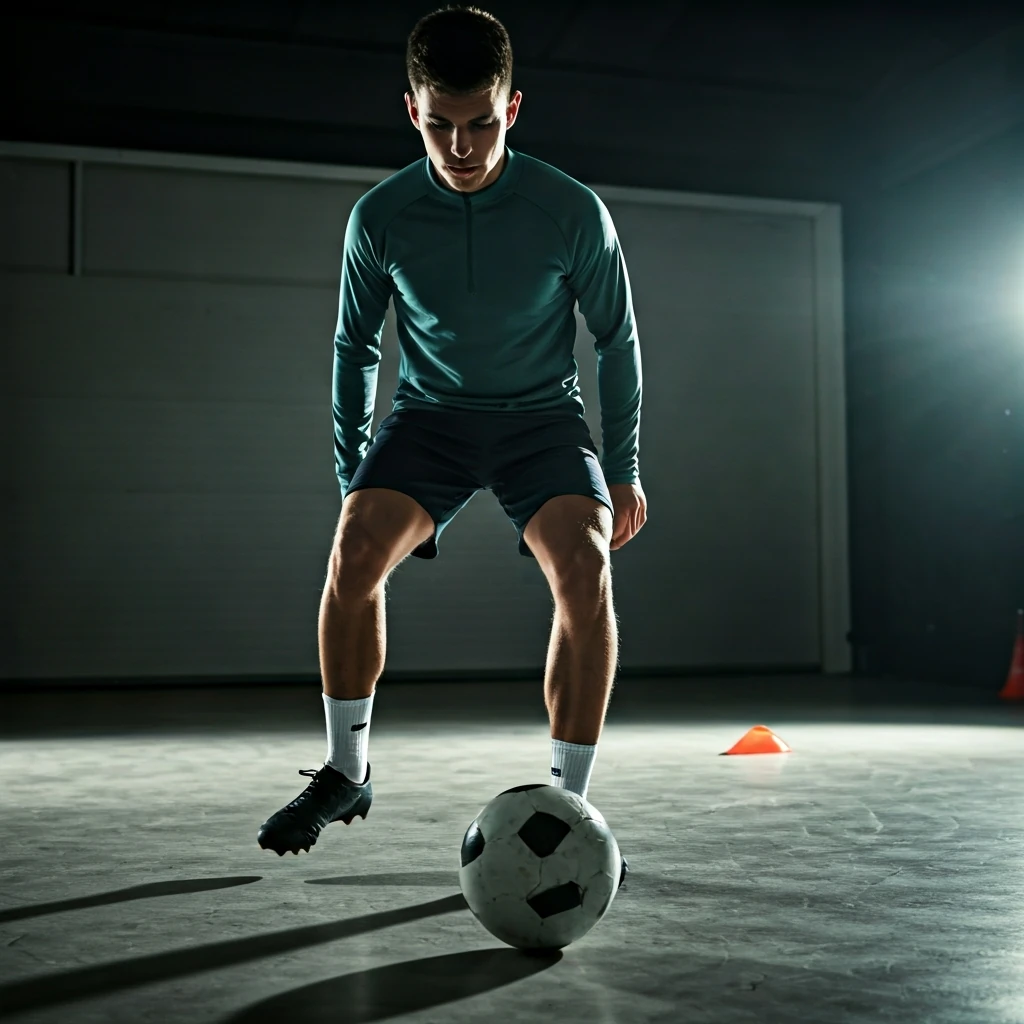
Keeping the ball under control while standing still is the first step to becoming unpredictable on the move. Use a small space to practice short, quick touches on the ball, keeping it close to you at all times. The goal is to feel the ball with different parts of your foot, alternating between right and left without having to look down.
These base movements are what build the confidence for more complex plays. Once you master short touches, you will be ready to explore the world of Dribbling in Soccer: Techniques and Secrets of the Stars. The idea is to make the ball dance at your command, ready to explode in any direction.
Short and Long Dribbling in Tight Spaces
Use cones, bottles or shoes as obstacles to create a small circuit. Practice zigzag dribbling with short, quick touches, keeping the ball as close to your body as possible. This movement is fundamental for protecting possession in congested areas of the field.
Then, on the same circuit, practice dribbling with slightly longer touches, pushing the ball a meter ahead of you and accelerating to catch up with it. This simulates the transition from shielding to attacking, when you find space to move forward. Alternating between these two styles in your at-home soccer training prepares you for any game tempo.
Improving Passing and Accuracy at Home
The ball at your feet is worthless if your pass is not weighted just right. To become an elite passer, your best training partner can be a wall. Good soccer passing practice starts with the basics: the side-foot pass. Use the inside of your foot to strike the ball against a solid surface, focusing on making it come straight back to you without deviating.
Correct posture is fundamental to passing accuracy. Keep your plant foot firmly beside the ball and your body leaning slightly over it. The secret lies in the full motion of your leg, following through even after contact. Practice exhaustively with both feet to become a versatile, unpredictable player on the field.
To increase the difficulty, play first-time passes. As soon as the ball comes back off the wall, return it without controlling it, which drastically improves your reaction time. Alternate with two-touch exercises: control the ball, set your body and play the pass. These individual passing exercises are intense and demanding on the body, so good Soccer Fitness Training: The Complete Guide is essential for keeping up the pace.
Fixed and Moving Targets for a Bigger Challenge
Turn a simple wall into a high-performance training zone. Draw a square with chalk or use tape to create a target. The goal is to hit it consistently, varying the power to practice short, low passes as well as slightly longer, lofted balls.
To simulate the dynamics of a game, create more complex scenarios. Place a cone or bottle a few meters from the wall. Your challenge is to kick the ball against the wall so that the rebound hits the target. This forces your brain to calculate angles and speeds, a skill that distinguishes ordinary players from those who truly decide a match.
Agility and Coordination: Pillars of Performance
A slow body does not win games. It is that simple. Skill on the ball is useless if you cannot create space, react to an opponent’s change of direction or get to the 50-50 ball first. Soccer agility training is not a luxury; it is the foundation that supports all your technical talent, turning potential into real performance between the lines.
Developing sharp motor coordination is what separates good players from stars. It is the ability to make your body obey your brain’s commands instantly, whether for a quick dribble or a sharp cut. Fortunately, you do not need a state-of-the-art training center to improve these attributes; the space in your home is more than enough.
An Adapted Agility Ladder
The agility ladder is a classic and extremely effective tool for improving footwork and quickness. If you do not have one, improvise! Use tape on the floor, chalk on the sidewalk or even sticks lined up in the backyard to create the “rungs”. The goal is to train the speed and precision of your movements in tight spaces.
Start with basic exercises, like stepping with one foot in each square and then with both feet. Then move on to lateral movements and alternating hops. The key is to keep your center of gravity low and your arm movements in sync, which improves balance and rhythm. Quick feet are the foundation of a deadly dribble, a fundamental topic explored in the guide Dribbling in Soccer: Techniques and Secrets of the Stars.
Exercises with Cones and Simple Objects
Water bottles, shoes or backpacks can serve as perfect markers to simulate opponents and obstacles. Place them in a zigzag to train quick changes of direction while maintaining body control. Another excellent exercise is the “slalom”, where you move between the objects as fast as possible, both forward and backward.
To increase the intensity, add a ball. Dribbling the ball between the makeshift cones forces you to lift your head, improving your vision while sharpening your soccer motor coordination under pressure. These at-home agility exercises replicate the chaotic conditions of a real match.
Jumps and Plyometrics for Explosiveness
Agility is not just about foot speed, but also explosive power. Plyometric exercises are designed to produce quick, powerful movements, essential for bursts of speed and jumps. They use the muscles’ stretch-shortening cycle to generate maximum force in minimum time.
Add jumps to your training, such as jumping onto a sturdy step or bench (box jumps), broad jumps and jump squats. These movements train your fast-twitch muscle fibers, resulting in more devastating acceleration on the field. Good Soccer Fitness Training: The Complete Guide always includes a plyometric component to develop this power.
Variations for Different Levels
The beauty of these workouts is their adaptability. If you are a beginner, concentrate on performing the movements correctly, even at a slower speed. Technique always comes before speed to avoid injuries and build a solid foundation. Gradually increase the intensity and complexity of the exercises.
For more advanced players, the challenge is different: shorten the rest time between sets, increase the speed of execution or combine exercises. For example, do a set on the agility ladder and immediately move on to a dribbling circuit through the cones. Remember that recovery is vital, and good Nutrition for Athletes: A Champion’s Fuel ensures your body has the energy to perform at its best.
Complementary Fitness Work: Strength and Endurance
Think the ball at your feet is all it takes to be a star? Think again. The most refined technique is worthless if your body cannot handle the grind of 90 minutes. Strength training at home is the foundation that supports your talent, making sure you have the strength to fight for the ball and the explosiveness to burst away.
Bodyweight exercises are your greatest allies. Squats and lunges build leg power for stronger shots, while planks strengthen the core, which is essential for balance in duels and changes of direction. Push-ups and pull-ups, if you have somewhere to do them, round out the work, strengthening the upper body so you can shield the ball in physical battles.
For soccer endurance, the key is keeping your heart rate up. Circuits of jumping jacks, burpees and running in place simulate the intensity of a match and improve your stamina. Integrating these exercises into your at-home soccer training is essential for complete soccer conditioning, a topic we cover in depth in our Soccer Fitness Training: The Complete Guide.
A Winning Mindset: Focus and Discipline in Individual Training
Technique is nothing without the right headspace. You can have the best at-home soccer training, but without the right mindset, your effort will be wasted. Discipline in soccer training is not just about working up a sweat, but about building the mental resilience that separates good players from stars. It is the daily commitment that turns potential into reality.
Focus in sport is your secret weapon when you train alone. At home, there is no coach shouting to motivate you, so the motivation has to come from within. That same willpower is what helps you maintain a Soccer Fitness Training routine and a Nutrition for Athletes: A Champion’s Fuel plan, creating a complete athlete.
Setting Clear, Achievable Goals
Dreaming of being the next number 10 is great, but how do you get there? The answer lies in setting small, specific, daily goals. Instead of “improve my shot”, set a goal like “hit the target 20 times with my left foot today”. These small wins build momentum and confidence, making the process of improvement visible and much more rewarding.
Create a weekly training schedule with clear objectives for each day. For example, Monday can be dedicated to ball control, Tuesday to agility and so on. Writing down your progress and celebrating each goal achieved reinforces the habit and keeps your motivation high, making discipline feel natural.
Visualization and Self-Confidence
The world’s greatest players play the match in their heads before they even step onto the field. Visualization is a powerful technique in which you create a mental movie of yourself executing perfect plays. Picture yourself pulling off that feint you learned in our guide to Dribbling in Soccer: Techniques and Secrets of the Stars, feeling the ball at your feet and watching the defender get left behind.
This practice strengthens neural connections and prepares your body to act as you imagined, building a winning soccer mindset. Combine visualization with positive self-talk to armor your self-confidence. Telling yourself that you are capable, focused and resilient turns your mind into your greatest ally on the road to success.
Transform Your Game: Consistency Is the Key
The secret to turning your game around is not magic, it is pure repetition. A heroic workout on the weekend is useless if you spend the rest of the time idle. Real improvement comes from consistency in soccer training, putting in a little every day to turn clumsy movements into automatic, instinctive actions.
Start with the basics and build from there, ensuring a progression in individual training that is sustainable and smart. Master ball control before trying complex feints and perfect the short pass before forcing long balls. Celebrating small daily wins keeps motivation high and builds a solid technical base for any challenge.
Remember that your technique only shines when your body can keep up. To truly get better at soccer, it is crucial to combine your technical dedication with excellent physical condition. Integrating the principles of good Soccer Fitness Training: The Complete Guide into your plan ensures you will have the explosiveness and endurance to apply your new skills for the full 90 minutes.
Turn Your Dedication into Dominance on the Field
We have reached the end of this guide, but for you, it is just the beginning of a new journey. The path to becoming a standout player is paved with consistency, and the tools you have learned here are the building blocks of your success. Remember: it is not the quality of your equipment, but the quality of your repetition that will make the difference. Every at-home training session is a deposit into your account of skill, confidence and resilience.
Refined technique, cat-like agility and the strength to last 90 minutes are cultivated through daily effort. Start small, be consistent and, above all, trust the process. The player you dream of being is waiting on the other side of your dedication. Grab your ball, find your space and start training today. The field will notice the difference.
Frequently Asked Questions About At-Home Soccer Training
How much time per day should I spend training soccer at home?
Consistency matters more than duration. Focused sessions of 20 to 45 minutes a day can produce much more significant results than long, sporadic workouts. The ideal is to create a sustainable routine you can keep up over the long term.
What are the best exercises for beginners doing at-home soccer training?
For beginners, the focus should be on fundamentals. Start with stationary ball control exercises, such as quick touches on the ball with the sole and inside of the foot. Also practice side-foot passes against a wall to improve your first touch and accuracy.
Do I need a lot of equipment to train soccer at home?
No, the beauty of training at home is its simplicity. The essentials are a soccer ball and a solid wall. Cones can easily be replaced with bottles, shoes or any other object that serves as a marker for dribbling and agility exercises.
How do I stay motivated to train alone at home?
To stay motivated, set small, achievable goals, such as mastering a new dribble or increasing the number of consecutive passes against the wall. Vary your exercises to avoid monotony, put on some upbeat music and track your progress so you can see how far you have come.
Does training at home replace team training?
No, it complements it. Training at home is essential for developing individual technique, ball control and confidence. Team training, on the other hand, is irreplaceable for tactical development, team chemistry and applying these skills in real game situations.